Imperishable Add-on Edit (Bg. 15.1)

Plate 35 of the 1972 Edition of Bhagavad-gita As It Is.  This painting is not to be found in the 1983 Edition of the Bhagavad-gita As It Is.

Plate 35 of the 1972 Edition of Bhagavad-gita As It Is.
Not to be found in the 1983 Edition.

By Ajit Krishna Dasa

Bhagavad-gita As It Is, 15.1

Original and authorised 1972 edition:

The Blessed Lord said: There is a banyan tree which has its roots upward and its branches down and whose leaves are the Vedic hymns. One who knows this tree is the knower of the Vedas.”

The draft a.k.a. “the original manuscript”:

The Supreme Lord said: It is said that there is a banyan tree which has its roots upward and its branches down; and the Vedic hymns are its leaves. One who knows this tree is the knower of the Vedas.”

Uauthorized 1983 edition:

The Supreme Personality of Godhead said: It is said that there is an imperishable banyan tree that has its roots upward and its branches down and whose leaves are the Vedic hymns. One who knows this tree is the knower of the Vedas.”

From lectures:

Pradyumna: (Translation:) “The Blessed Lord said: There is a banyan tree which has its roots upward and its branches down and whose leaves are the Vedic hymns. One who knows this tree is the knower of the Vedas.”

Prabhupada: So this is the description of Vedic literature. Vedais ca sarvair aham eva vedyah [Bg. 15.15]. That will be described. (Srila Prabhupada, Lecture, See Spiritual Identity Everywhere,
73/10/28 Bombay, Bhagavad-gita 15.1)

Nitai dasa: Translation: The Blessed Lord said: There is a banyan tree which has its roots upward and its branches down and whose leaves are the Vedic hymns. One who knows this tree is the knower of the Vedas.

Purport: After the discussion of the importance of bhakti-yoga, one may question, “What about the Vedas?” (Srila Prabhupada, Lecture, The Purpose of Vedic Study 74/02/26 Calcutta, Bhagavad-gita 15.1)

No objections from Srila Prabhupada.

Comment

1) We here observe that Jayadvaita Swami, after scanning the authorized verse, takes the usual route to an old draft (the so-called original manuscript). An idea for which he has no proper justification.

2) He decides to change “The Blessed Lord”. Here he could have chosen to use Srila Prabhupada’s words from the draft’ translation of Bg. 15.1 which reads “The Supreme Lord said”, but he chose instead to go to the English synonyms and use “The Supreme Personality of Godhead”.

3) Next he decides to add “It is said”. This he took from the drafts’ translation of Bg. 15.1.

4) Then he decides to add an adjective to “banyan tree”. He could have gone back to the English synonyms and used the word “eternal”. But instead he took a trip to the drafts’ purport where he for some reason chose the word “imperishable” over the word “indestructible” which is also in the purport. NOTE: The word “imperishable” is omitted from the purport of both the original 1972 edition and the 1983 edition which makes his choice even more strange.

5) He then changes “which” to “that” even though “which” was both found in the draft and was grammatically perfectly fine. In other words, he found the word “that” not in the English synonyms, not in the translation and not in the purport. But in his own mind.

Hundreds of changes to Srila Prabhupada’s Gita have been documented online. And we see Jayadvaita Swami again and again randomly chose words sometimes from the manuscripts’ translations, sometimes from the English synonyms, sometimes from the purport and sometimes from his own mind.

For the most part it is very hard to find any objective and identifiable criteria for his changes. Especially for changes such as those above. And there are hundreds, if not thousands, of such changes in the Gita alone.

BBT Editorial Policy for Future Editors

The BBT International is apparently in the process of creating editorial policies for future editors i.e. editors working AFTER the present editors’ retirement.

Guidance for Future BBT Editors

Proposed BBT Editorial Policy for Future Editors

For now, we at Arsa-Prayoga are simply putting this up for everyone to see:

Hare Krishna
Please accept my obeisances. All glories to Srila Prabhupada

The BBT Global Communications team have requested our assistance in widely circulating as far as possible (in ISKCON circles) the draft of the proposed BBT editorial policy to allow for devotees to comment.

Please can you assist in this regard as this is a very important and sensitive subject.

Below is a standard cover letter you can use and attached is the draft policy

I have cc’d in Smita Krsna Prabhu and Rasika Bandhu Prabhu who are co-ordinating this communique for BBT

Your servant
Nanda Kishor das

———————

Dear Devotees

Hare Krishna

Please accept our humble obeisances. All glories to Srila Prabhupada.
Attached kindly find for your perusal and comment the BBT Editorial Policy.

Kindly send all comments by no later than 20 September 2015 to:
BBT.Global.Communications@pamho.net

The BBT directors, at their latest meeting, had an extended discussion
about Srila Prabhupada’s purport to Srimad-Bhagavatam verse 4.25.41. We will
soon send out a separate memo about that, letting you know where those
thoughts led and seeking your comments.

Yours in the service of Srila Prabhupada
BBT Global Communications

Link to the Guide for Future BBT Editors.

BBTI’s Gives Mutually Exclusive Justifications for the editing of Perfect Questions, Perfect Answers

Perfect_Questions_Perfect_Answers-cover

By Ajit Krishna Dasa

In 1993 BBT International published a new edition of Srila Prabhupada’s Perfect Questions, Perfect Answers. Madhudvisa Prabhu wrote about this:

“The original edition was more or less a transcript of the original conversation. It was edited, of course, to make the English clear and correct and to make it readable. But basically it remained a transcript of the original conversation.

The 1993 version changes all of this. The book is slashed from 99 pages to 77 pages! And the type is not even smaller! So much has been cut out. In one place four complete pages have been deleted!

All the text has been heavily edited and the whole mood of the book has been completely changed. We have not done anything below about the editing, we have just pointed out a few pieces of text (shown in bold) that have been completely deleted from the new edition.” (http://bookchanges.com/iskcon-perfect-questions-perfect-answers-book-changes/)

The BBT International has tried to justify the changes to Perfect Questions, Perfect Answers. But their attempted justifications are mutually exclusive.

BBTI’s Attempted Justification 1

“In the mid-1990s the BBT published a second edition of Perfect Questions, Perfect Answersedited by a less experienced BBT editor. Because readers of this edition pointed out numerous editorial discrepancies, the BBT directors resolved in 2002 that Dravida Dasa will review the book before its next printing. Either he will correct the discrepancies, or the BBT will revert to the first edition.” (ISKCON Communications Journal Vol. 11, Editing the Unchangeable Truth: An Overview of the Editorial History of the Books of His Divine Grace A. C. Bhaktivedanta Swami Prabhupada, 2005)

In 1996 the editing is of Perfect Questions, Perfect Answers was described by Jayadvaita Swami as follows:

Screen Shot 2015-08-03 at 13.13.04

(From Madhudvisa Dasa’s ISKCON’s Changes to Srila Prabhupada’s Bhagavad-gita As It Is and Perfect Questions, Perfect Answers)

In this letter Jayadvaita Swami mentions the name of the “less experienced editor” (Sita Devi Dasi), and he claims that her editing made the new version read “more smoothly” and made it “closer to the original transcription”. But he later had to admit that this new and less experienced editor was allowed to change the books of Srila Prabhupada without proper supervision, and that her editing was not good enough.

So this is how Jayadvaita Swami’s explanations sounded in 1996 and 2005 respectively. But a few years ago one of his colleagues posted the following on the internet:

BBTI’s Attempted Justification 2

“A report from Ranjit das, BBTI:

No good deed goes uncriticized.

The story of Perfect Questions Perfect Answers reprint

Recently someone has tried to stir up a new criticism of the BBT by pointing to the re-print (in the 1990’s) of the book Perfect Questions Perfect Answers. Some 20 pages were taken out of the book. Why?

At that time PQPA had been out of print for a long time. The devotee in charge of operations really wanted to re-print the book because he liked it so much. However there was a problem. The book was around 120 pages long. The small books that the BBT were printing at the time had been formatted into 96-page books so that the printers would give a really good price. If PQPA were printed at the 120 plus pages then most of the distributors would not buy them and distribute them because such books as Perfection of Yoga, Beyond Birth and Death, etc were cheaper.

What to do?

Our devotee in charge of operations read the book and a good section consisted of a conversation between Srila Prabhupada and an Indian gentleman who was also present at the time. So our devotee figured that this part could go because it was not really part of the conversation between Bob Cohen (now Brahmatirtha Das) and Srila Prabhupada. But this was just not enough to bring it down to the 96-page format so a few more pages were cut.

Srila Prabhupada himself authorized the same thing with the abridged Gita. This devotee simply followed the precedent. But Srila Prabhupada wanted the word to go out and so did our intrepid BBT manager. And now this is being pointed to as some kind of conspiracy. So our BBT manager, instead of being lauded for the 96 pages that were printed and distributed is criticized for the 20 pages that he did not.” (https://www.facebook.com/bbtedit/posts/10152724990094126)

Like I said, these stories are mutually exclusive. Take a look:

Screen Shot 2015-08-03 at 10.28.07

In addition to this, Madhudvisa Prabhu has documented that in fact the second edition has not just had sections and pages cut out. Quite a few individual words and sentences have been randomly removed. Here is a link to Madhudvisa Prabhu’s comparisons. Please check it out yourself.

Our questions to BBT International: What is correct here? The first or second explanation? Or a combination? Or a third or fourth explanation?

Uneven Edit (Bg. 2.48)

bg-2-48

BY: BHAKTA TORBEN

Jun 17, 2015 — DENMARK (SUN) —  Bhagavad-gita As It Is, 2.48:

Original, authorized 1972 edition: 

“Be steadfast in yoga, O Arjuna. Perform your duty and abandon all attachment to success or failure. Such evenness of mind is called yoga.”

Manuscript: 

“Do your prescribed duty in an equipoised condition. To do such duty without being attached to success or failure, and to remain in an equiposed condition is called Yoga.”

Read Aloud to Srila Prabhupada by Tamala Krishna in London, 1968: 

“Be steadfast in your duty, O Arjuna, and abandon all attachment to success or failure. Such evenness of mind is called yoga [Bg. 2.48].”

And immediately after Tamal Krishna’s reading of the verse Srila Prabhupada says:

“This is the explanation of yoga, evenness of mind. Yoga-samatvam ucyate. If you work for Krsna, then there is no cause of lamentation or jubilation. Jubilation is there because you are working for Krsna, but there is no cause of lamentation. Yoga-sthah kuru karmani, yogah karmasu kausalam. That is the secret of activities, how you can very diligently work at the same time you are not entangled with the actions. That is the secret. Go on.”

The word-for-word reads ‘samatvam – evenness of mind‘ (Original), but the heavily edited ‘JAS It Is’ version says in the word-for-word ‘samatvam – equanimity’.

‘JAS It Is’:

“Perform your duty equipoised, O Arjuna, abandoning all attachment to success or failure. Such equanimity is called yoga.”

Once again we observe an absolutely unnecessary change. This verse in the original 1972 edition is perfect.

There are more irregularities. Check it out.

Failed De-Sexing Edit Attempt (Bg. 2.23 and 2.24)

BY: BHAKTA TORBEN

May 14, 2015 — DENMARK (SUN) —

Bhagavad-gita As It Is, 2.23:

Screen Shot 2015-06-11 at 13.38.38

Original, authorized 1972 edition: 

“The soul can never be cut into pieces by any weapon, nor can he be burned by fire, nor moistened by water, nor withered by the wind.”

Manuscript: 

“The soul can never be cut into peices by any kind of weapon, neither can he be burnt by fire, nor can He be moistened by water, nor can he be dried up by the wind.”

JAS It Is: 

“The soul can never be cut to pieces by any weapon, nor burned by fire, nor moistened by water, nor withered by the wind.”

Although both the manuscript and the original says he about the soul, the JAS It is-version has, for unknown reasons, dropped the pronoun.

Paradoxically, however, ‘Jas It Is’ version in the ensuing verse, 2.24, does NOT drop the pronoun ‘he‘ for the soul:

Bhagavad-gita As It Is 2.24:

Original, authorized 1972 edition: 

“This individual soul is unbreakable and insoluble, and can be neither burned nor dried. He is everlasting, all-pervading, unchangeable, immovable and eternally the same.”

Manuscript: 

“This individual soul is unbreakable, cannot be burnt, insoluble, nondriable, everlasting, present everywhere, unchangeable, immovable and eternally the same.”

JAS It Is. 2.24:

“This individual soul is unbreakable and insoluble, and can be neither burned nor dried. He is everlasting, present everywhere, unchangeable, immovable and eternally the same.”

So the ‘JAS It Is’ edit-strategy seems to be pretty fickle. “Should we, or shouldn’t we?”

Anyway, why not just stick to the original? It is pretty clear.

In London, 1973, BOTH of the original’s verses were read aloud to Srila Prabhupada.

Superfluous and Awkward (Bg. 3.26)

BY: BHAKTA TORBEN

May 18, 2015 — DENMARK (SUN) —

Bhagavad-gita As It Is, 3.26:

Screen Shot 2015-06-10 at 12.21.52

Original, authorized 1972 edition: 

“Let not the wise disrupt the minds of the ignorant who are attached to fruitive action. They should not be encouraged to refrain from work, but to engage in work in the spirit of devotion.”

Manuscript: 

“Those who are after the fruitive results of prescribed duties may not be induced to stop work, disrupt his intelligence. Rather they should be engaged in all sorts of activities, for gradual development of Krsna consciousness.”

JAS It Is:

“So as not to disrupt the minds of ignorant men attached to the fruitive results of prescribed duties, a learned person should not induce them to stop work. Rather, by working in the spirit of devotion, he should engage them in all sorts of activities [for the gradual development of Krishna consciousness].”

The original is fine and lucid.

The ‘Jas It Is’ edition is a threefold mix of the original and the manuscript plus added stuff, i.e., the words ‘So as not to’ and ‘a learned person’ .

The bracketed sentence in the end ‘for the gradual development of Krishna consciousness’ is a pleonasm to the sentence ‘working in the spirit of devotion’, therefore superfluous and the end-result is awkward.

There is more, check it out.

Performer Edit (Bg. 14.19)

BY: BHAKTA TORBEN

Apr 02, 2015 — DENMARK (SUN) —

Bhagavad-gita As It Is, 14.19:

Original, authorized 1972 edition:

“When you see that there is nothing beyond these modes of nature in all activities and that the Supreme Lord is transcendental to all these modes, then you can know My spiritual nature.”

Manuscript:

“When you see that there is nothing beyond these modes of Nature in all activities — and that the Supreme Lord is transcendental to this, then you can know My spiritual Nature.”

Screen Shot 2015-04-03 at 14.58.14

Jas It Is:

“When one properly sees that in all activities no other performer is at work than these modes of nature and he knows the Supreme Lord, who is transcendental to all these modes, he attains My spiritual nature.”

The Original and the manuscript agrees TO THE LETTER. Both the manuscript and the original says `You can know My spiritual nature´, whereas `Jas It Is´ says `he attains to My spiritual nature. The word-for-word says, ‘vetti’- know.

The phrase, ‘no other performer‘ is not found in the original or the manuscript.

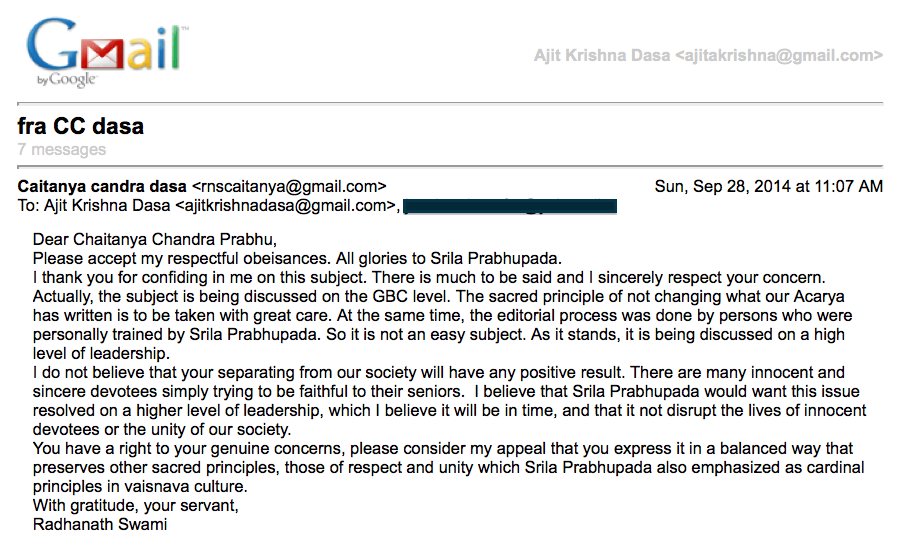
Radhanath Swami on the book changes (leaked e-mail)

In September 2014 Radhanath Swami sent the below e-mail to one of his Danish disciples, Caitanya Candra Dasa:

Screen Shot 2015-03-29 at 10.03.33

Here is the text in digital format:

“Dear Chaitanya Chandra Prabhu,
Please accept my respectful obeisances. All glories to Srila Prabhupada.
I thank you for confiding in me on this subject. There is much to be said and I sincerely respect your concern. Actually, the subject is being discussed on the GBC level. The sacred principle of not changing what our Acarya has written is to be taken with great care. At the same time, the editorial process was done by persons who were personally trained by Srila Prabhupada. So it is not an easy subject. As it stands, it is being discussed on a high level of leadership.
I do not believe that your separating from our society will have any positive result. There are many innocent and sincere devotees simply trying to be faithful to their seniors. I believe that Srila Prabhupada would want this issue resolved on a higher level of leadership, which I believe it will be in time, and that it not disrupt the lives of innocent devotees or the unity of our society.
You have a right to your genuine concerns, please consider my appeal that you express it in a balanced way that preserves other sacred principles, those of respect and unity which Srila Prabhupada also emphasized as cardinal principles in vaisnava culture.
With gratitude, your servant, Radhanath Swami

An analysis:

We can see that Radhanath Swami is an intelligent diplomat.

RS: “I thank you for confiding in me on this subject.”

Radhanath Swami tries to maintain a relationship of trust. He makes it seem as if he appreciates Caitanya Candra Dasa’s questions, and invites him to open up his heart.

RS: “There is much to be said…”

This could make it seem as if Radhanath Swami has some special knowledge about the book changes, and as if it is a great mystery (secret knowledge) that requires deep and intense study, sadhana and special association to understand. But what Radhanath Swami is really saying, I guess, is that he does not know much about this matter, and that he is not going to speak much about it – neither to Caitanya Candra Dasa nor publicly.

RS: “…and I sincerely respect your concern.”

Radhanath Swami makes it seem as if he truly shares Caitanya Candra Dasa’s concerns. He speaks as if they are on the same side – that of genuine concern. But Radhanath Swami’s statement is trivial, for who does not care for Srila Prabhupada’s books? Everyone will say they care. Everyone will say that the editing should be done in a way that pleases Srila Prabhupada. But notice that Radhanath Swami does not disclose his own personal opinion. He really says nothing at all.

RS: “Actually, the subject is being discussed on the GBC level. The sacred principle of not changing what our Acarya has written is to be taken with great care. At the same time, the editorial process was done by persons who were personally trained by Srila Prabhupada. So it is not an easy subject. As it stands, it is being discussed on a high level of leadership.”

Here we again see Radhanath Swami’s diplomatic skills at work. He is indirectly saying that Caitanya Candra Dasa should not care much about it because it is being taken care of “on a high level of leadership”. Radhanath Swami says: “Do not worry! The GBC will handle it! Go back to sleep!”

But we all know what “a high level of leadership” in ISKCON means! It means incompetent devotees creating new problems while trying to solve already existing problems caused by themselves.

And what is the proof that the GBC are talking about this? It was not mentioned in the GBC resolutions of 2015. Maybe Radhanath Swami is misinformed or twisting the truth trying to buy time. Or maybe there is really a committee of around 3 members who are all pro-change who speaks about the book changes 2 hours per year trying to figure out how to close the mouths of the protesters.

Why should we accept Radhanath Swami’s “assurance” that the GBC is handling this issue? For all we know he could be lying. He presents no proof.

Radhanath Swami tries to balance things out by acknowledging that it is important not to change the words of our Acarya. But at the same time, he says, we should remember that those who did the changes were personally trained by Srila Prabhupada. Radhanath Swami uses the same diplomatic skills as Duryodhana on the battlefield first glorifying Drona and then Bhisma. He is saying to Caitanya Candra Dasa: “You are good, and they are also good! Therefore it is all very complicated and can only be solved at GBC level! Please go back to sleep!”

RS: “So it is not an easy subject.”

It really does not take much of a brain to see that Jayadvaita Swami and BBTI have violated the arsa-prayoga big time. But either Radhanath Swami will not write this online, or he is in denial or simply does not know much about what has been done to Srila Prabhupada’s books.

What we do know is that he is diplomatic, and that he is not going to risk his own prestige and position by speaking about the book changes online or publicly.

Factually, by his silence Radhanath Swami is accepting the changes made to Srila Prabhupada’s books by the BBTI, and by encouraging his disciples to also stay silent, he is also encouraging them to accept the changes.

RS: “There are many innocent and sincere devotees simply trying to be faithful to their seniors. I believe that Srila Prabhupada would want this issue resolved on a higher level of leadership, which I believe it will be in time, and that it not disrupt the lives of innocent devotees or the unity of our society.”

Radhanath Swami seems to have failed to understand that the so-called “higher level of leadership” in ISKCON has had more that 30 years to resolve this very simple issue. But they have continuously made the situation worse. Instead of stopping all editing while investigating the matter thoroughly they have allowed BBTI to continue editing many of Srila Prabhupada’s books.

We have absolutely no reason to believe or trust that the BBTI or GBC are capable of solving this issue on their own. And since they will not listen we have to challenge them to answer publicly. There is no other way. It is their own fault that this subject is being debated publicly.

And to claim that it is dangerous for new devotees to hear of such controversial topic is simply foolish. Our first concern in spiritual life is to make sure that the scriptures we read are bona fide. This is ABC and all new devotees are taught this in the temples, and it is written in all of Srila Prabhupada’s small introductory books. So if there is any doubt about the authenticity of the books, then all devotees need to know.

The funny thing is that we know for sure that the original books are bona fide and have the power to deliver us. But we are not sure if the changed editions have that potency. As a guru Radhanath Swami ought to have at least the amount of intelligence to understand that we must stop printing the changed books until we know for sure which editions are bona fide. Better safe than sorry.

But Radhanath Swami has never stepped forward to ask the BBTI to stop their editing while the matter is being investigated.

Instead Radhanath Swami suggests that we leave this crucial matter to incompetent “high level leaders”, while we sleep our way back to Godhead. Are these foolish instructions on the book changes really coming from a bona fide spiritual master?

RS: “You have a right to your genuine concerns, please consider my appeal that you express it in a balanced way that preserves other sacred principles, those of respect and unity which Srila Prabhupada also emphasized as cardinal principles in vaisnava culture.

With gratitude, your servant, Radhanath Swami”

Radhanath Swami tries to close the correspondence in a mood of friendship. He has said something and at the same time nothing. Radhanath Swami prefers that Caitanya Candra Dasa keeps quiet about this matter and leaves it to the “high level leaders”. At the same time Radhanath Swami knows that Caitanya Candra Dasa might not want to keep his mouth shut, so he implores him to speak in a balanced way if he speaks about it.

At no point did Radhanath Swami state his own opinion about the book changes, and he did not help Caitanya Candra Dasa understand this most important issue. If Radhanath Swami really was a bona fide guru, then he should easily be able and willing to clear the doubts of his disciples on this matter. But it seems he cannot do that. Or maybe he choses to let his disciples stay in the darkness of ignorance in order not to get himself into trouble.

This is not how a guru works. A guru is not a diplomat. A guru is straight forward. A guru want to help his disciples. He wants to save them from ignorance and the offences of violating the arsa-prayoga principle.

Some of our local ISKCON authorities in Denmark have tried to impress upon the Danish devotees that Caitanya Candra Dasa is violating his guru’s instructions by speaking about the book changes. But we can see this is false. Radhanath Swami says that Caitanya Candra Dasa has the right to be concerned about the book changes, and he does not prohibit Caitanya Candra Dasa from speaking publicly about the book changes – for whatever reason.

BBTI FORCED TO THEIR KNEES

Due to intense pressure from tens of thousands of devotees worldwide the BBTI have been forced – against their will – to again print the original edition of Srila Prabhupada’s Bhagavad-gita As It Is.

Screen Shot 2015-02-13 at 11.26.48

http://www.dandavats.com/?p=15528

But why support the BBTI, when they use the money to destroy Srila Prabhupada’s books?

Also, the original edition from BBTI is not as good quality as the one sold from Krishna Books Inc.

My recommendation: Buy your original books from http://www.krishnastore.com or any other shop that sells the original books as printed by Krishna Books Inc. (KBI).

Hidden Co-Authors

Screen Shot 2015-02-13 at 11.12.53

Krsna Krpa dasi (Mary E. Corens, M.A., M.Ed. )*

Part I – Hidden Co-Authors

Misconceptions have been circulating about the authorship of His Divine Grace A.C. Bhaktivedanta Swami Prabhupada (Srila Prabhupada).  For example, it is a mistake to think that his books were written by his editors.  The facts demonstrate that Srila Prabhupada translated, wrote, edited, and published his books while using his disciples as assistants.  In contrast, the so-called editing of his books without his knowledge and consent is really rewriting by hidden co-authors.

EXTRAORDINARY AUTHOR

Srila Prabhupada is an extraordinary author unsurpassed in history because he translated, wrote, edited, published, and distributed millions of books worldwide, translated in many languages. He trained hundreds of disciples to assist him in this monumental work. Srila Prabhupada created his own publishing house, the Bhaktivedanta Book Trust (BBT). He created his own distribution system of temples, the Life Membership program, and book distributors who developed innovative methods to distribute books. He engaged millions of people in producing, distributing and receiving his transcendental books, and thus engaged them in the pure devotional service of Lord Caitanya’s movement.

Srila Prabhupada was a published author before he reached America. In India, without help, he translated, wrote, edited, published and distributed the three volumes of Srimad Bhagavatam, First Canto, the paperback Easy Journey to Other Planets, and many issues of Back to Godhead magazine. He wrote a second manuscript for the Bhagavad-gita to replace his first one which had been stolen.

Of course, he recognized his difficulties in presenting transcendental knowledge in a foreign language. In the Preface to each volume of Srimad Bhagavatam, he appealed to the readers: “I must admit my frailties in presenting Srimad Bhagavatam, but still I am hopeful of its good reception by the thinkers and leaders of society on the strength of the following statement of Srimad Bhagavatam (1.5.11): tad-vag visargo… ‘On the other hand, that literature which is full with descriptions of the transcendental glories of the name, fame, form and pastimes of the unlimited Supreme Lord is a transcendental creation meant to bring about a revolution in the impious life of a misdirected civilization. Such transcendental literatures, even though irregularly composed, are heard, sung and accepted by purified men who are thoroughly honest.’”

Once he arrived in America, he took opportunities to correct his “irregular composition.” He gave a large stack of papers, his Bhagavad-gita manuscript, to his disciple, Hayagriva das, who had a Masters degree in English. The two of them worked closely together to edit and prepare the manuscript for publication in the United States.

AMAZING SYSTEM TO WRITE AND PUBLISH

Srila Prabhupada’s published letters reveal an amazing system which he organized to accelerate his writing. He controlled every aspect from beginning to end. And he trained his disciples to assist him in various ways. He dictated translations and purports which his disciples transcribed. He corrected and edited those transcriptions which were then sent to other disciples for more editing. He edited the Sanskrit synonyms or provided them himself. He proofread manuscripts and final drafts. He gave specific instructions regarding illustrations, number of pages, size, paper, binding, covers, printing and costs. He examined the printed books to see if they had been printed properly. He noted his satisfaction and dissatisfaction. If necessary, he ordered corrections for a subsequent printing. Amazingly, he did all this work using personal meetings and regular postal mail while traveling around the world!

Srila Prabhupada wrote letters to convey his instructions and answer questions. Excerpts demonstrate his direct involvement in training and correcting his disciples’ work. He wrote his books by dictating the translations and purports which were transcribed. “I have received the transcription of tape #16. You are doing very nicely and improving your editorial capability.” (Letter to Satsvarupa, July 29, 1969) “Pradyumna and Shyamsundar will be sending you regularly completed transcriptions of my translation work by post … and because I am here, if they have questions, I can answer and make the final proofreading, and this will expedite everything.” (Letter to Jayadvaita, May 15, 1971)

His disciples had difficulty producing quality translations and Sanskrit synonyms even in later years, thereby forcing Srila Prabhupada to do the work himself. “The translations… I am not using. There is some fault. I am doing the translations… (Letter to Radhaballabha, Sept. 26, 1975) “Yes, because no one else can do them, I shall do the Sanskrit synonyms.” (Letter to Jayadvaita, Feb. 18, 1972) “From yesterday night I have begun adding the synonyms as it doesn’t save very much time to have the synonyms.” (Letter to Radhaballabha, Oct. 20, 1975) “I will have to see personally what are the mistakes in the synonyms and also how you intend to correct them. I was not satisfied with the corrections that were made before. I saw some changes which I did not approve. Nitai may correct whatever mistakes are there, but the corrected material must be sent to me for final approval.” (Letter to Radhaballabha, Jan. 5, 1976)

Synonyms were missing for 25 chapters of the Srimad Bhagavatam, so he provided them. “I have begun this work and the first tape of synonyms, tape no. 6, was sent to Pradyumna today. This work will take at least one month to complete.” (Letter to Jayadvaita, Feb. 18, 1972) Sometimes he provided the synonyms within the letter: “So far your question, the synonyms are as follows: sattvam – the mode of goodness; rajas – the mode of passion … (Letter to Jayadvaita, July 3, 1971)

Srila Prabhupada’s solution to the Sanskrit editing problems was to train his disciple, Pradyumna das. “I am very much glad that Pradyumna is now with me for teaching him correctly this Sanskrit editing work. After he has become well-trained that will be a great relief to me and it will benefit everyone by increasing the flow of our books and literatures.” (Letter to Jayadvaita, May 15, 1971)

Srila Prabhupada also trained his disciples in editing the English and preparing the manuscripts for publishers, including basic proofreading. As always, he reviewed their work and made necessary corrections. “Regarding your second point, all incarnations should be proper nouns and therefore capitalized. It does not matter whether they are Visnu-tattva or jiva-tattva, saktavesh-avatar or plenary expansion.” (Letter to Jayadvaita, July 12, 1970) “…you have got 31 only out of 33. I think some of the brackets are not counted. So if the parentheses are removed from ‘intoxication’ and ‘impotency’ and they are also counted, the total of symptoms will come to 33. Simply add commas…” (Letter to Jayadvaita, Jan. 30, 1970)

Srila Prabhupada supervised his editors; he reviewed their work, including the final manuscript. “Regarding the corrections you have sent, this kind of changes is admissible. There is no harm.” (Letter to Radhaballabha, Sept. 21, 1975) “I have received your letter dated May 26, 1972, along with the blue-print copies of Bhagavad Gita As It Is from MacMillan Company. It is very nice. So I shall be looking forward to seeing the entire manuscript and book sometime around first July, 1972.” (Letter to Jayadvaita, May 28, 1972)

Srila Prabhupada gave instructions and reviewed the art work to illustrate his books. “The sketches are all alright as they are. Please go ahead and make the paintings.” (Letter to Jadurani, Jan. 5, 1976) For Sri Caitanya-Caritamrta, he wrote, “The art paintings are very, very good. Everyone likes them, and I know they have worked especially hard…. The photographs are also wonderful. He has done nicely, the boy Bhargava.” (Letter to Radhaballabha, Sept. 26, 1975)

Other examples include the illustrations in the Seventh Canto of Srimad Bhagavatam (1st printing, 1976) which comply with his instructions. “2. There should be no effulgence around Prahlad. Hiranyakasipu should not be shown with a pipe. He was a non-smoker.… 4. To illustrate Prahlad being protected when he is thrown off the cliff, there should be a semi-visible Krishna waiting below, as if to catch.” (Letter to Radhaballabha, Feb. 3, 1976)

Srila Prabhupada determined the layout of his books and other publishing details. He wanted high quality publications. “Regarding 6th Canto, Nitai has just yesterday sent off Chapters 5, 6, 7 and 8 and next week he expects to send off Chapters 9 through 13. This will be sufficient for you to publish one volume.” (Letter to Radhaballava, Sept. 21, 1975) Regarding a decrease in the printing quality of Back to Godhead magazine, he wrote, “The color is not at all good. It is not attractive, and not as good as Dai Nippon…. The standard quality of Dai Nippon must be maintained. On what consideration is the printer being changed?… In my opinion, no one can print better than Dai Nippon. Why is the plan changed without my consent?… We cannot change the quality of printing for the matter of a little change in the price. This printing is not approved by me…. I am sending copies of this letter to all BBT Trustees for necessary action.” (Letter to Radhaballava, Sept. 22, 1974)

Srila Prabhupada was a prolific writer – he translated and wrote faster than his disciples could edit and publish. Although he was one person and they were many, they could not keep up with him. For example, he pressured his disciples for years to publish the eighteen volumes of Sri Caitanya-Caritamrta. The manuscripts were written, but the editing, illustrations, and publication progressed slowly. The first published volume appeared in 1973. A year later, another volume was published. He overcame BBT’s lethargy in 1974 by forcing the Los Angeles temple into a marathon to prepare the books. And he personally stayed there to assist the editors. By his efforts, the entire Sri Caitanya-Caritamrta was finally published in 1975.

Other books took longer. In 1972 he ordered the publication of a paperback based on recorded conversations. “I think we are just now typing up the tapes of those conversations we held in Mayapur, and we shall be publishing them as a book. It will be called Perfect Questions, Perfect Answers.” (Letter from Srila Prabhupada to Bob Cohen, June 16, 1972, reprinted in the book) Five years later, the small paperback was published and ready for distribution.

Srila Prabhupada’s system of book distribution relied on three integral parts – his temples, his book distributors, and the Life Membership program. The temples were the regional centers for book distribution. They organized the local distribution and provided all the needs for the book distributors and support persons (managers, pujaries, cooks, etc.) who lived in the temples. The temple activities were organized so that the book distributors could devote all their energies to distributing Srila Prabhupada’s books and preaching. “There is no doubt about it, to distribute books is our most important activity. The temple is a place not for eating and sleeping, but as a base from which we send out our soldiers to fight with maya. Fight with maya means to drop thousands and millions of books into the lap of the conditioned souls. Just like during war time the Bombs are raining from the sky like anything.” (Letter to Ramesvara, Aug. 3, 1973)

Srila Prabhupada devised the Life Membership Program as a scheme to publish and distribute books in India, and to expand it to America and other countries. “Here in India our program is going on very nicely. Especially we are making so many life members. That program is so important that we are getting money, supporters and distributing our literature all at the same time.” (Letter to Damodara, March 5, 1971) “…on this book distribution scheme of life membership. 50% is utilized for reprinting books and 50% is utilized for increasing the number of centers. I think the same program may be vigorously introduced in your country and that will be a great success.” (Letter to Rupanuga, Feb. 19, 1971)

ERRONEOUS MISCONCEPTIONS

It is clear that Srila Prabhupada was the author of his books, and the editors were his assistants. Also, he fully controlled the editing and publishing process. For his books, he determined the content, meaning, purpose, audience, style, illustrations, binding, paper, publication dates, etc.

So why do some, including some BBT editors, erroneously claim that Srila Prabhupada did not really write his books? Why do they mistakenly refer to “Hayagriva’s Bhagavad-gita” instead of “Srila Prabhupada’s Bhagavad-gita?” The answer is that they confuse writing with editing.

Factually, editing is not writing because editing polishes something already written. First the author writes, and then the editor edits. First, Srila Prabhupada wrote the translations and purports for Bhagavad-gita, and then Hayagriva edited them.

Writing creates the content, meaning and purpose. Editing polishes that work to make it more presentable to the readers, but editing does not change the author’s meaning and purpose. Srila Prabhupada created the transcendental content of his books. He conveyed the meaning of Krsna consciousness within the Vaisnava parampara (disciplic succession). And he imbued his books with the purpose to spread Lord Caitanya’s mercy all over the world. Srila Prabhupada’s books contain his potency to transform sincere readers into pure unalloyed devotees. To assist him, Hayagriva polished the Bhagavad-gita manuscript by correcting the irregular composition without changing Srila Prabhupada’s meaning and purpose.

Editing differs from writing because the editor suggests changes and consults with the author for approval. Hayagriva proofread the Bhagavad-gita manuscript. Proofreading is the process of finding and correcting errors in spelling, conjugation, capitalization, grammar, syntax, italics, etc. as well as conformity to the publisher’s format (font size, margins, indentations, footnotes, etc.).

Hayagriva also suggested other changes to the manuscript. Like a good editor, he discussed the changes and asked for Srila Prabhupada’s approval of them. Other disciples acting as editors followed the same approval process with other books. It is clear that Srila Prabhupada wrote his books and that Hayagriva and other disciples edited them.

Another misconception is that Srila Prabhupada’s books can be edited without his knowledge and consent. This is erroneous because, as explained above, editing requires discussions and approval from the author. And the author makes the final decisions about what is published. Therefore, no editing can occur especially after Srila Prabhupada’s disappearance (in 1977) because he is no longer available for consultation. The only exceptions would be found in his orders for specific changes to specific books. Regarding the unfinished Srimad Bhagavatam, he personally trained and assigned only Pradyumna das to finish the translations and purports.

Still another misconception is that Srila Prabhupada gave orders to change his published books after his disappearance. No evidence exists to support this claim. In fact, he gave many orders not to change his books. “Yes, there is no need for corrections for the first and second Cantos. Whatever is there is alright.” (Letter to Radhaballabha, May 4, 1976) Regarding the Bhagavad-gita manuscript prepared for the 1972 MacMillan publication, he wrote, “So far changing the working of verse or purport of 12:12 discussed before, it may remain as it is.” (Letter to Jayadvaita, March 17, 1971) Apparently Srila Prabhupada rejected Jayadvaita’s suggestions in favor of leaving the manuscript “as it is.” Yet three words in that purport were changed for the unauthorized 1983 revision. **

Those familiar with Srila Prabhupada’s management understand that he would have given important orders to change his published books to the BBT Trustees, the GBC members, and Pradyumna, his highly qualified translator. So why are there no orders from Srila Prabhupada to his important leaders? Why would he grant permission to rewrite his Bhagavad-gita to devotees who were not important leaders before his disappearance?

HIDDEN CO-AUTHORS

What is so-called editing that is independent from Srila Prabhupada’s order? Factually, it is not editing, it is rewriting of his books. The so-called editors are acting like authors. They are really co-authors because they are rewriting books written by another author, i.e., Srila Prabhupada. And, they are really hidden co-authors because they rewrite his books while hiding behind the good name of His Divine Grace A.C. Bhaktivedanta Swami Prabhupada. The hidden co-authors present their own translations and opinions hidden within Srila Prabhupada’s books.

In contrast, honest co-authors always publish their names, and sometimes they describe their individual contributions. In any case, their readers understand that two or more authors wrote the book. A famous example of co-authoring is a book about grammar and writing, The Elements of Style by William Strunk Jr. and E.B. White (Fourth edition, 2000, published by Longman Publishers). In it, White explained his role as co-author and his changes to Strunk’s original book. White also claimed credit for writing the section on style.

CHANGES TO THE BOOKS

The problem of hidden co-authors even occurred during Srila Prabhupada’s physical presence. Some disciples deviated from the honest relationship between Srila Prabhupada as author and the disciples as editors. Such persons changed his manuscripts and printed books without his permission and knowledge. After discovering these unauthorized changes, Srila Prabhupada strongly chastised the persons involved and demanded the removal of the changes. For example, during a Srimad Bhagavatam class, Nitai das read a manuscript translation which contained unauthorized changes.

Nitai: “At the time of death, Ajamila saw three awkward persons… His small child, Narayana, was playing a little distance off, and with tearful eyes and great anxiety, he called the name of his son very loudly three times, ‘Narayana, Narayana, Narayana!” (SB 6.1.28-29)
Srila Prabhupada: Is there “three times?”
Nitai: It said in the manuscript. The manuscript said “three times.”
Srila Prabhupada: Who said in the manuscript? There is no three times. Not “Narayana” three times. One time, “O Narayana,” that’s all. So did I say “three times?” No, it is not said here. You should correct it. Once, “O Narayana,” that’s all. There is no reason of calling three times. There is no mention here. Once is sufficient. (laughter) …Uccair ajuhava, very loudly, “Narayana!” Like that. That’s all. Uccair ajuhava akulendriyah. So you edited it? Not yet?
Nitai: No
Srila Prabhupada: So you should keep at least what is there. (Transcription of recorded lecture for S.B. 6.1.28-29, Philadelphia, July 13, 1975)

Despite his continual efforts to rectify and train his editors, they continued to make unauthorized changes. By June of 1977, Srila Prabhupada expressed his doubt that his leading editors would follow his order to remove over 100 changes to the Sri Isopanisad and publish it as the original (1969) printing.   He said, “It is a very serious situation. You write one letter that ‘Why you have made so many changes?’ And whom to write? Who will care? All rascals are there! Write Satsvarupa that ‘This is the position. They are doing anything and everything at their whim. The next printing should be again to the original way.”  (Conversation with with Srila Prabhupada and Yasoda-nandana, June 22, 1977)

After Srila Prabhupada’s disappearance, the hidden co-authors made major changes to Bhagavad-gita As It Is (1972 edition). A major change is the language, the writing style, of the Bhagavad-gita translations. For example, Srila Prabhupada originally published (1972 edition), Chapter 7, verse 24 as “Unintelligent men, who know Me not, think that I have assumed this form and personality. Due to their small knowledge, they do not know My higher nature, which is changeless and supreme.” In contrast, the hidden co-authors (1983 revision) rewrote the verse as “Unintelligent men, who do not know Me perfectly, think that I, the Supreme Personality of Godhead, Krsna, was impersonal before and have now assumed this personality. Due to their small knowledge, they do not know My higher nature, which is imperishable and supreme.”

The stark contrast between the two versions clearly indicates that they were written by two different authors. Srila Prabhupada wrote the original version, and the hidden co-authors wrote the later version.

Other Bhagavad-gita verses in the rewritten, 1983 edition display similar changes. The hidden co-authors substituted a lower level writing style not intended for college educated readers. Therefore, the change in writing style indicates a change in audience, the intended readers. Srila Prabhupada wrote for a college-educated, more intelligent audience; whereas, the hidden co-authors wrote for a less intelligent audience.

The co-authored Bhagavad-gita (1983 revision) is not suitable for college classrooms. But Srila Prabhupada’s plan differed: “…our propaganda should be going on for drawing attention of the educational institutions to accept our books at least in the religious courses.” (Letter to Satsvarupa, Nov. 2, 1973) “I am so glad to learn that you are having nice success in placing my books in the libraries and in schools and colleges…. I am sure that this will revolutionize the thinking of thoughtful men of your country as well as the students and the professors and the ultimate end will be to save the world from the clutches of material illusory activities which is now causing havoc everywhere.” (Letter to Karandhar, Sept. 13, 1970)

Why do the hidden co-authors claim to be better translators and commentators (purport writers) than Srila Prabhupada? What are the hidden co-authors doing when they change the philosophy and preaching plans in Srila Prabhupada’s books? What is their purpose?

The hidden co-authors usurp Srila Prabhupada’ property, his books, by making changes not authorized by him. They seize and hold his books by force without the spiritual right to do so. The hidden co-authors force changes without any order to do so. They blatantly disobey his direct order to maintain the books as originally published. They use BBT money and diplomacy to defeat opposition to their usurpation. The hidden co-authors behave like squatters who forcibly and unlawfully take over someone’s property and use it for their own purpose.

The hidden co-authors mislead the devotees and the innocent public by publishing their own opinions under Srila Prabhupada’s good name. What is their purpose? They are acting like hidden founder-acaryas because they rewrite sastra (Vedic scripture) intended for the next 9500 years. Because they reject Srila Prabhupada’s order to maintain his books as published, they freely inject their own opinions.

The proper behavior of a disciple or follower is to follow the spiritual master’s order. Srila Prabhupada explained: “Visvanatha Cakravarti Thakura has stated that the order of the spiritual master is the life and soul of the disciples. As a man cannot separate his life from his body, so a disciple cannot separate the order of the spiritual master from his life. If a disciple follows the instruction of the spiritual master in that way, he is sure to become perfect.” (Srimad Bhagavatam 3.24.13, 1974, 1st printing)

On the basis of this instruction, sincere devotees have the duty and the right to reject all co-authored changes to Srila Prabhupada’s books. We must follow Srila Prabhupada, not the hidden co-authors because he can liberate anyone who follows him.

Srila Prabhupada wrote: “Not a single person in the West became Krsna conscious before the Krsna consciousness movement was founded. But when the same Bhagavad-gita was presented as it is through the disciplic succession, the effect of spiritual realization was immediately manifested.”   (Srimad Bhagavatam, 4.22.19, 1978, 2nd printing)

By following Srila Prabhupada, we can make spiritual progress and preach Lord Caitanya’s movement all over the world. And Srila Prabhupada, through his Prabhupada-vani – his books and teachings, can take anyone back home, back to Godhead.

*The late wife of Rupanuga das, who wrote this essay anonymously in 2006 and posted it on Adi-vani

**This instruction was followed in 1972 edition. When challenged why the changes were made later in the 1983 edition, after Srila Prabhupada’s disappearance, the following reply was received.

“The story on 12:12:

I asked Srila Prabhupada whether the sequence of items mentioned in the verse (which to me seemed inconsistent with the Sanskrit) should be changed. He said no. Respecting his order, I left the verse as is.

Srila Prabhupada gave a very specific answer to a very specific question.

Someone now wants to extend Srila Prabhupada’s specific answer to make it a general order to the effect that not a word of the purport should be changed. And so the obviously erroneous “regulated principles” — a term that makes no sense — must be forever preserved, and not revised to the usual and sensible “regulative principles,” lest we stand in defiance of Srila Prabhupada’s sacred order.

This is a point of view with which I respectfully disagree.”
From Jayadvaita Swami August 25, 2011

Actually in 12:12 Srila Prabhupada is referring to the general practices or regulations of devotional service or Bhakti Yoga, not simply the “four regulative principles”.