Frivolous Change of Chapter-heading

Help us by “liking” and “sharing” this post!
sp1

The text below was sent to the BBT International through their website (http://www.bbtedit.com/contact) and to Jayadvaita Swami and Dravida Prabhu’s personal e-mails (jswami@pamho.net, jayadvaita.swami@pamho.net, dravida108@gmail.com) the 7th Feb. 2014. We asked them to comment on the points raised.

So far we have not received any reply.

BY: BHAKTA TORBEN (re-posted from Sampradaya Sun)

Dec 20, 2013 — DENMARK (SUN) — The sixth chapter of Srila Prabhupada’s original Bhagavad-gita is called “SANKHYA-yoga”. And Prabhupada often spoke of the sixth chapter like that. Here are a few examples:

“That is the perfection of yoga. When Krsna has advised yoga practice, sankhya-yoga… You have Bhagavad-gita? There is -SANKHYA-yoga. You’ll find in the forty-seventh verse. This is the version.”
(Room Conversation – May 10, 1969, Columbus, Ohio)

“In the Sixth Chapter He has explained the SANKHYA-yoga system and the concluding portion of the sankhya-yoga system is:

yoginam api sarvesam
mad-gatenantar-atmana
sraddhavan bhajate yo mam
sa me yuktatamo matah”
(Bhagavad-gita 6.47 – Ahmedabad, December 12, 1972)

Prabhupada’s draft [so called original manuscript. This was personally typewritten by Srila Prabhupada]:

Skærmbillede 2013-12-20 kl. 10.17.55

“How can we sit down silently and do nothing? It is not possible. Therefore, after Sri Krsna outlined the SANKHYA-yoga system in the Sixth Chapter of Bhagavad-gita,…”
(Path of Perfection 1: Yoga as Action)

“…Thus end the Bhaktivedanta purports to the Fifth Chapter of the Srimad Bhagavad-gita on the subject of karma-yoga or acting in Krsna consciousness.”

Prabhupada: All right. Then we shall… SANKHYA-yoga shall I begin today or next day? This is a new chapter, we shall begin next day. (end)”
(Bhagavad-gita 5.26-29 – Los Angeles, February 12, 1969)

“That means one who is keeping always in Krsna consciousness, “abides in Me with great faith, worshiping Me in transcendental loving service is most intimately united with Me in yoga, and is the highest of all.” This is the prime instruction of this chapter, SANKHYA-yoga, that if you want to become perfect yogi of the highest platform, then keep yourself in Krsna consciousness and you become the first-class yogi.”
(Bhagavad-gita 6.46-47 — Los Angeles, February 21, 1969)

“That is also stated in the SANKHYA-Yoga chapter of Bhagavad-gita:

yoginam api sarvesam
mad-gatenantar-atmana
sraddhavan bhajate yo mam
sa me yuktatamo matah
[Bg. 6.47]

(Bhagavad-gita 7.1 – Calcutta, January 27, 1973)

BUT BUT BUT

Jayadvaita Swami changed Bhagavad-gita So-called As It Is, which says DHYANA-yoga for the sixth chapter IN SPITE of Srila Prabhupada calling it SANKHYA-yoga in many, many places.

Question arises: This seems such a NEEDLESS change. How dare one correct Srila Prabhupada on this one?

Your servant, no ill intended,

Bhakta Torben

Here we post many more examples where Prabhupada says that the sixth chapter of Bhagavad-gita As It Is deals with sankhya-yoga:

“So we have been discussing Bhagavad-gita. In Second Chapter, the Lord has very elaborately explained the constitutional position of the living entity, and the whole first portion of the Six Chapter. The Bhagavad-gita is divided into three portions. The first six chapter, the second six chapters and the third six chapters. Actually just like this book, there are two hard covers, and in the middle there is the substance, writing. So the first six chapters, they are just like two coverings. Karma-yoga and jnana-yoga. And the middle six chapters, well-protected, that is bhakti-yoga. So at the end of the first six chapters, Krsna concludes the yoga system. In the Sixth Chapter He has explained the sankhya-yoga system and the concluding portion of the sankhya-yoga system is:

yoginam api sarvesam
mad-gatenantar-atmana
sraddhavan bhajate yo mam
sa me yuktatamo matah”
[Bg. 6.47] >>> Ref. VedaBase => Bhagavad-gita 6.47 — Ahmedabad, December 12, 1972

“Thus end the Bhaktivedanta Purports to the Sixth Chapter of the Srimad-Bhagavad-gita in the matter of Sankhya-yoga Brahma-vidya.” >>> Ref. VedaBase => Bg 6.47

“Prabhupada: Hare Krsna. Sankhya-yoga is the astanga-yoga. This sitting posture and meditation, this is called sankhya-yoga.
(69/02/16 Los Angeles, Bhagavad-gita 6.13-15)

“Lord Caitanya’s teachings are identical to those given by Lord Kapila, the original propounder of sankhya-yoga, the sankhya system of philosophy. This authorized system of yoga recommends meditation on the transcendental form of the Lord. There is no question of meditating on something void or impersonal. One can meditate on the transcendental form of Lord Visnu even without practicing involved sitting postures. Such meditation is called perfect samadhi. This perfect samadhi is verified at the end of the Sixth Chapter of the Bhagavad-gita, where Lord Krsna says, “And of all yogis, the one with great faith who always abides in Me, thinks of Me within himself, and renders transcendental loving service to Me-he is the most intimately united with Me in yoga and is the highest of all. That is My opinion.”” (Bg. 6.47) >>> Ref. VedaBase => Cc. 1975-Preface

“It is our duty to act in Krsna consciousness because we are constitutionally parts and parcels of the Supreme. The parts of the body work for the satisfaction of the entire body, not for the individual parts. The goal is the satisfaction of the complete whole. Similarly, the living entity should act for the satisfaction of the supreme whole, the Supreme Personality of Godhead, and not for his own personal satisfaction. One who can do this is the perfect sannyasi and the perfect yogi. In the first verse of the Sixth Chapter of Bhagavad-gita, the chapter dealing with sankhya-yoga, Bhagavan Sri Krsna states,

anasritah karma-phalam
karyam karma karoti yah
sa sannyasi ca yogi ca
na niragnir na cakriyah

“One who is unattached to the fruits of his work and who works as he is obligated is in the renounced order of life, and he is the true mystic, not he who lights no fire and performs no work.”” >>> Ref. VedaBase => PoP 1: Yoga as Action

“Krsna Himself does not sit down idly. All His pastimes are filled with activity. When we go to the spiritual world, we will see that Krsna is always engaged in dancing, eating, and enjoying. He does not sit down to meditate. Is there any account of the gopis meditating? Did Caitanya Mahaprabhu sit down to meditate? No, He was always dancing and chanting Hare Krsna. The spirit soul is naturally active. How can we sit down silently and do nothing? It is not possible. Therefore, after Sri Krsna outlined the sankhya-yoga system in the Sixth Chapter of Bhagavad-gita, Arjuna frankly said,

yo ‘yam yogas tvaya proktah
samyena madhusudana
etasyaham na pasyami
cancalatvat sthitim sthiram

“O Madhusudana [Krsna], the system of yoga which You have summarized appears impractical and unendurable to me, for the mind is restless and unsteady.” (Bg. 6.33) Although Arjuna was highly elevated and was Krsna’s intimate friend, he immediately refused to take up this sankhya-yoga system.” >>> Ref. VedaBase => PoP 1: Yoga as Action

In this Sixth Chapter, in which the Lord speaks of the sankhya-yoga system, He states from the very beginning that one cannot become a yogi unless one renounces the desire for sense gratification.” >>> Ref. VedaBase => PoP 2: Mastering the Mind and Senses

In this Sixth Chapter of Bhagavad-gita, the system of sankhya-yoga, which is the meditational astanga-yoga system, is emphasized.” >>> Ref. VedaBase => PoP 4: Moderation in Yoga

“Here it is clearly stated that there are many types of yogis-astanga-yogis, hatha-yogis, jnana-yogis, karma-yogis, and bhakti-yogis — and that of all the yogis, “he who always abides in Me” is said to be the greatest of all. “In Me” means in Krsna; that is, the greatest yogi is always in Krsna consciousness. Such a yogi “abides in Me with great faith, worshiping Me in transcendental loving service, is most intimately united with Me in yoga, and is the highest of all.” This is the prime instruction of this Sixth Chapter on sankhya-yoga: if one wants to attain the highest platform of yoga, one must remain in Krsna consciousness.” >>> Ref. VedaBase => PoP 8: Failure and Success in Yoga

Devotee: “These preface perfection by devotional service which alone can award peace to the human being and is the highest goal of life. Thus end the Bhaktivedanta purports to the Fifth Chapter of the Srimad Bhagavad-gita on the subject of karma-yoga or acting in Krsna consciousness.”
Prabhupada: All right. Then we shall… Sankhya-yoga shall I begin today or next day? This is a new chapter, we shall begin next day. (end) >>> Ref. VedaBase => Bhagavad-gita 5.26-29 — Los Angeles, February 12, 1969

Prabhupada: Now, here it is clearly stated that of all yogis, there are different kinds of yogis. Astanga-yogi, hatha-yogi, jnana-yogi, karma-yogi, bhakti-yogi. So bhakti-yoga is the highest platform of yoga principles. So Krsna says here, “And of all yogis.” There are different kinds of yogis. “Of all yogis he who always abides in Me,” in Krsna. Me means Krsna says “in Me.” That means one who is keeping always in Krsna consciousness, “abides in Me with great faith, worshiping Me in transcendental loving service is most intimately united with Me in yoga, and is the highest of all.” This is the prime instruction of this chapter, Sankhya-yoga, that if you want to become perfect yogi of the highest platform, then keep yourself in Krsna consciousness and you become the first-class yogi. >>> Ref. VedaBase => Bhagavad-gita 6.46-47 — Los Angeles, February 21, 1969

“If you want to learn Krsna, if you want to know Krsna, then you have to take this process. Mayy asakta-manah partha yogam. And if you practice this yoga, krsna-yoga, or bhakti-yoga, then you become the topmost of all yogis. That is also stated in the Sankhya Yoga chapter of Bhagavad-gita:

yoginam api sarvesam
mad-gatenantar-atmana
sraddhavan bhajate yo mam
sa me yuktatamo matah”
[Bg. 6.47] >>> Ref. VedaBase => Bhagavad-gita 7.1 — Calcutta, January 27, 1973

“In Europe and America the yoga principle is very popular because they think by practice of yoga, they’ll have very good health and they can use their senses very nicely. That is yoga system. The fatty woman goes to the yoga class for reduce fat. That is yoga system. You see. Somebody is going to practice yoga system for making right the liver action. You see. Here is yoga: vasudeva-para yogah. That is… Krsna also says in the Yoga chapter, Sankhya-yoga chapter, Krsna says,

yoginam api sarvesam
mad-gatenantar-atmana
sraddhavan bhajate yo mam
sa me yuktatamo matah”
[Bg. 6.47] >>> Ref. VedaBase => Srimad-Bhagavatam 1.2.28-29 — Vrndavana, November 8, 1972

“These Krsna conscious persons, people, they are also yogis, bhakti-yogis. They are the best of the yogis. As we see in the Bhagavad-gita, in the chapter in which Sankhya yoga has been explained, the conclusion is, yoginam api sarvesam: [Bg. 6.47] “Of all the yogis…” Yoginam api sarvesam mad-gatenantar-atmana: “One who is thinking within himself about Me, Krsna,” mad-gaten… sraddhavan, “with faith and love,” bhajate mam, “engaged in My devotional service,” sa me yuktatamo matah, “he is the first-class yogi. He is the first-class yogi.” >>> Ref. VedaBase => Srimad-Bhagavatam 5.5.1 — London, August 30, 1971

“Of course, those who are too much engrossed with the bodily concept of life, they have been recommended to practice the hatha-yoga system. That is also mentioned in the Srimad-Bhagavad-gita. Just like you’ll find in the “Sankhya-yoga.” This Bhagavad-gita As It Is, as we have published, page number 153, there is a statement how one should practice this transcendental meditation. Verse number thirteen and fourteen, it is said, “One should hold one’s body, neck and head erect in a straight line.” >>> Ref. VedaBase => Northeastern University Lecture — Boston, April 30, 1969

“Prabhupada: Yoginam api sarvesam: “Of all the yogis…” Yoginam api sarvesam. That is the last verse of the yoga chapter, sankhya-yoga chapter. Yoginam… When Arjuna said that “This practice of astanga-yoga is not possible for me.” >>> Ref. VedaBase => Room Conversation — December 13, 1970, Indore

“Therefore it is conclusive that so called yoga followers are simply cheated and they are wasting their time. I have already explained these points in the Sankhya yoga chapter of the Bhagavad-gita As It Is, so you read them carefully and present it, point by point, in suitable occasions.” >>> Ref. VedaBase => Letter to: Satsvarupa — Hawaii 19 March, 1969

Prabhupada on Brahma-Samhita: It should be left as is!

Help us by “liking” and “sharing” this post!

Sri_Brahma-Samhita-cover

In Brahma Samhita by Bhaktisiddhanta Sarasvati Thakura, Introduction, page xvi (page 7 in the PDF):

“…As per Srila Prabhupada’s instructions regarding the publication of this volume, Bhaktisiddhanta Sarasvati’s somewhat technical and sometimes difficult prose has been left intact and virtually untouched. Fearing that any editorial (grammatical and stylistic) tampering with Bhaktisiddhanta’s text might result in inadvertant changes in meaning, Prabhupada asked that it be left as is, and the editors of this volume have complied with his wishes…”

Ramesvara Prabhu remembers regarding that same publication og Brahma Samhita:

“What about the incorrect grammar? “Prabhupada’s reply, “You cannot change one comma, not even a comma, not even a punctuation mark, that is the etiquette.” So that was just another one of those super heavy instructions that the etiquette in dealing with a great acarya’s books is that whatever he has done it’s eternal and it can never be changed. And I believe that all of this was part of Prabhupada’s training us . He wanted to train people who would be entrusted with his books.” (Ramesvara, Interview 1979)

The Brahma-Samhita was published with only very slight editing done:

  • Typographical errors was corrected.
  • Capitalization was standardized.
  • Sanskrit terms in devanagari script appearing within the English text was transliterated.
  • Already transliterated terms have been adjusted to international standards.
  • The original devanagari text was added for each verse. It was followed by roman transliteration, and then by a word-for-word translation into English (none of these appeared in the original edition).

This very limited editing of Brahma-Samhita were made under the instructions of our Sampradaya-Acarya, Srila Prabhupada, who is a pure unalloyed devotee of the Lord. No mistakes and no offenses would be made as long as he supervised and approved the work. In addition, the editors were honest and wrote in the introduction precisely what they did to the original work. The BBT International should also be honest by letting the readers know what they did to Prabhupada Bhagavad-gita As It Is. Something like this ought to be written:

Despite the fact that Srila Prabhupada educated us in the vedic principle of arsa-prayoga that state that the words of the acarya should not be corrected, we, the editor’s, have made extensive posthumous changes and corrections to Prabhupada’s personally typewritten sanskrit translations. We have also added completely new words, sentences and paragraphs and made re-arrangement of words and sentences. Original paintings and pictures have been removed and exchanged with new ones. We have also removed the foreword and changed the cover. All editing is done without the approval of the author. We can’t guarantee that our editing is free from mistakes, or that the author would be pleased with the editing.

Prabhupada’s instructions on front covers not honored

Help us by “liking” and “sharing” this post!

5528_100788686601936_7223238_n

The text below was sent to the BBT International through their website (http://www.bbtedit.com/contact) and to Jayadvaita Swami and Dravida Prabhu’s personal e-mails (jswami@pamho.net, jayadvaita.swami@pamho.net, dravida108@gmail.com) the 7th Feb. 2014. We asked them to comment on the points raised.

So far we have not received any reply.

Here we see, in the background, the painting Prabhupada chose for the front cover of his Bhagavad-gita As It Is (standing yet unframed on the floor).

He was very happy about that painting, and he wished that Deities precisely resembling Krishna and Arjuna on the painting be made for the alter on the Gita-Nagari farm.

“Srila Prabhupada began to sow the seeds of inspiration in directing the future development of Gita-nagari farming community.  Prabhupada confirmed today that the presiding Deity should be Krsna and Arjuna, exactly as on the cover of the Bhagavad-gita.” (Tamal Krishna Goswami’s Diary, Prabhupada’s Final Days, August 30)

He also desired that the pictures on he covers on his books should remain the same on all their respective translations into other languages. This wish has, unfortunately, never been honored.

Prabhupada:

“And the covers, if possible, should always be the same for each respective book regardless of what language it may be printed in.” (Letter to Jadurani, Bombay, January 3, 1975)

An unfortunate local example of an unauthorized cover can be read in the links below:

DANISH BHAGAVAD-GITA AS IT IS COVER AGAINST PRABHUPADA’S INSTRUCTIONS

DANISH BBT INTERNATIONAL EDITORS COVERS THE GREATNESS OF BHAGAVAD-GITA AND PRABHUPADA

Time for honesty from the BBT International

Help us by “liking” and “sharing” this post!

Text by Bhajahari and Palaka Prabhus

If the present editors of the BBTI insist on continuing their unauthorised revisions of Srila Prabhupada’s Bhagavad-gita As It Is – they should at least make it clear that what they are now publishing is NOT the original.

Simple honesty would be good.

Don’t you think?

1485908_574307139305587_32311085_o

This is really how the BBT(I) editors should do their gita cover with regard to full disclosure so the buyer is fully aware it is a revised edition they are looking at.

See Rupanuga Prabhu’s article on this specific subject matter of EDITING PROTOCOL.

Jayadvaita Swami: There are warts on Prabhupada’s books

Help us by “liking” and “sharing” this post!

Parasurama_leading_kirtan_in_OsloParasurama Prabhu leading kirtan

Reposted from the Sampradaya Sun:

Warts on Books

BY: PARASURAM DAS

Dec 15, 2013 — UK (SUN) — Are there warts on Srila Prabhupada’s books, or are there no warts? (Warts on Books, Part 4b, 4.28) A difference of opinion (difference of understanding) has arisen- should the books be changed to fix these warts? No changes as the books are perfect? And the warts are only in the minds of the academic editors?

A strong divide has arisen in regards to the “changes” made to Srila Prabhupada’s Bhagavad-gita since 1977. I was asked recently about the difference between the two Bhagavad-gitas: “This one was written by Lord Krishna through Srila Prabhupada and the other one I am not sure.” I apologise in advance as I admit to being confused, as many of us are, and I was hoping that the audio attached may throw some light.

There is a serious concern as on Saturday 3rd May, 2013 at Bhaktivedanta Manor during class, HH Jayadvaita Maharaj was asked the 84 million dollar question: “When will there be an end to the editing, “changing”? The Definite Bhagavad-gita (Part 4a, 5.20) The answer being, when himself and Dravida prabhu leave their bodies… (Part 4a 6.57) but no guarantee of no changes even then.

Alarm bells are ringing… number of changes already made to the book and a licence to continue. Pictures changed and omitted, Mayavad philosophy inserted and only recently removed, editing out Srila Prabhupada’s unique style of language…

I believe HH Jayavaita Maharaj has overstepped the mark, creating division and uncertainty over the law books for the next 10,000 years. Then again, who am I? Not the sharpest pencil in the pack! But this topic should be addressed soon, as in the future there will be great confusion. There is another 10,000 years to go.

Concerns:

1. The ongoing editing, changing and omitting with no end in sight.
2. Creating division in our society.
3. 2.61 purport… Visnu platform added (Mayavad philosophy), only recently changed back to the way it was. Shows that the editors are capable of making serious mistakes.
4. Many places changed or omitted where Srila Prabhupada had actually given class from and had even spoken about the omitted topics.
5. A major concern is that Srila Prabhupada’s unique style of language and phrases have been replaced.

Warts on Books, Part 4a (MP3)

Warts on Books, Part 4b (MP3)

Your servant,
Parasuram das

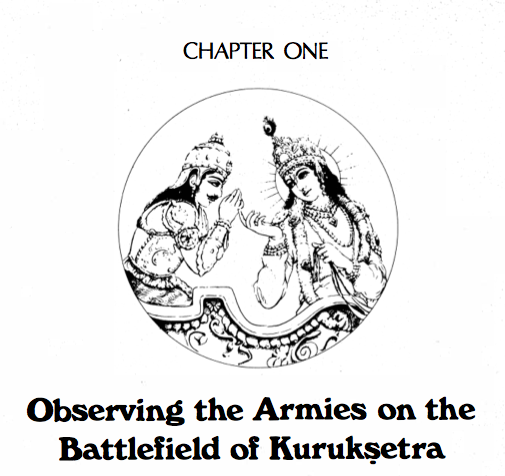
Tampering with Prabhupada’s personally typewritten sanskrit translations (BG, Chapter One)

Please help us by “liking” and “sharing” this post!

Skærmbillede 2013-12-09 kl. 22.03.15

The text below was sent to the BBT International through their website (http://www.bbtedit.com/contact) and to Jayadvaita Swami and Dravida Prabhu’s personal e-mails (jswami@pamho.net, jayadvaita.swami@pamho.net, dravida108@gmail.com) the 7th Feb. 2014. We asked them to comment on the points raised.

So far we have not received any reply. 

By Ajit Krishna Dasa and Bhaktin Anna Nygaard

In regard to the posthumous editing of Prabhupada’s Bhagavad-gita As It Is, Jayadvaita Swami has expressed (emphasis added by Arsa-Prayoga staff):

1982:

“Comparing each verse in the book with the text of the manuscript, I made only those changes that to me seemed worthwhile. I tried to be conservative and not make needless changes.” (Jayadvaita Swami, letter to senior devotees, October 25, 1982)

1986:

“As you know, and as we kept in mind while doing the work, Srila Prabhupada staunchly opposed needless changes.” (Jayadvaita Swami, Letter to Amogha Lila, 1986)

1995:

“When Srila Prabhupada conveyed to us the conclusions of the previous acaryas, he did so perfectly, preserving and transmitting the philosophy exactly as it is, neither watering anything down, nor covering anything over, nor leaving anything out. He gave us the essence of everything.

We therefore don’t need to add anything, subtract anything, or change anything. We need only faithfully serve Srila Prabhupada’s orders, and everything will be revealed.” (Jayadvaita Swami, Sri Vyasa Puja book August 19,1995)

2009:

On BBT International’s website we find this video:

Transcription of the video:

Arsa-Prayoga is a very important principle. The editor should never have the mentality that he’s better than the author, that he has something more to contribute than the author does, that the author really doesn’t know what he is doing, but he knows what he is doing. That’s offensive! And that is…ruins everything! It is an offense to the acarya. The idea, however, that this sort of sanctity that the author’s text has, or that the words of the author have, somehow extends to the mistakes of the editors…is weird! “It’s an offense to correct the mistakes of previous editors!” Are they acaryas? Are they paramahamsas? Are they infallible? They are wonderful devotees, they did wonderful service. But they made mistakes. Understandably.”

Summing up Jayadvaita Maharaja’s standpoints from the above:

In 2009 Jayadvaita Swami admits that the principle of arsa-prayoga is very important, and that it is an offense to violate it. He admits that Prabhupada’s text has sanctity, and that the editors of Prabhupada’s books should never think they are better than Prabhupada and has more to contribute than Prabhupada.

In 1995, twelve years after Prabhupada’s disappearance, Jayadvaita Swami said that we should not add, subtract or change anything in the teachings Prabhupada has given us. Earlier, in 1982 and 1986, Jayadvaita Swami claimed that they had in mind not to make needless changes in their editing of Bhagavad-gita As It is, because Prabhupada staunchly opposed such needless changes. They only changed what they felt was worthwhile changing. However, Jayadvaita Swami further states that the sanctity that Prabhupada’s texts have do not apply to the work done by Prabhupada’s editors (he seem not to appreciate the fact that this work was later approved by Prabhupada. Does Prabhupada’s approval not have sanctity?)

In this way Jayadvaita Swami makes it seem as if he did not add, subtract or change any of Prabhupada’s direct words (except for the grammatical errors, capitalisation and commas). However, during the last three decades, we and many other devotees have observed and documented numerous needless changes made by Jayadvaita Swami to Prabhupada’s Bhagavad-gita As It Is. And in spite of Jayadvaita Swami’s own seeming interest in not adding, subtracting or changing anything in Srila Prabhupada’s teachings, the posthumously edited books contain all of these three types of edits (adding, subtracting and changing).

We will now start a series of articles documenting the changes made to the sanskrit synonyms (word for word meanings) in the first six chapters of the Bhagavad-gita As It Is. Why only the first six chapters?

According to Jayadvaita Swami the first five or six chapters of the draft (often referred to as the ”original manuscript”) to the Bhagavad-gita As It Is was personally typewritten by Srila Prabhupada himself.

Jayadvaita Swami writes on his website:

”Some books Srila Prabhupada wrote out in longhand or typed himself. These include Easy Journey to Other Planets, Sri Isopanishad, the first and second cantos of Srimad-Bhagavatam, the first five or six chapters of Bhagavad-gita As It Is,…” (Jayadvaita Swami, Editing the Unchangeable Truth, How Were the Books Written?, Reprinted from ISKCON Communications Journal, Volume 11, 2005)

If anything has sanctity, apart from the finished manuscripts that Prabhupada sent to the press for printing, it must be the words that he himself wrote on his type-writer. We would most certainly not expect to see any changes made to these. Even if they contain mistakes, these mistakes should not be corrected according to the principle of arsa-prayoga.

However, we do see significant changes made to the sanskrit translations that Prabhupada personally wrote on his type-writer. By comparing the posthumously edited 1983 edition with both the 1972 MacMillan edition and the so called “original manuscript” we see that the 1972 MacMillan edition is much closer to and faithful to Prabhupada’s original words.

This is especially interesting because Prabhupada was very concerned with better knowing disciples that had become “learned” in sanskrit:

“…a little learning is dangerous, especially for the Westerners. I am practically seeing that as soon as they begin to learn a little Sanskrit immediately they feel that they have become more than their guru and then the policy is kill guru and be killed himself.” (from a letter to Dixit das on 18 Sep 1976)

We now publish for the first time a complete list over all the changes made to Prabhupada’s personally type-written sanskrit translations. Here is the complete list for Chapter One.

PDF: bg-comparing-OM-1972-1983-ch1  

Direct link: https://www.dropbox.com/s/d9u09z5jxnwj50d/bg-comparing-OM-1972-1983-ch1.pdf

New video with Ramesvara Prabhu from “Prabhupada Memories” about the book changes

Help us by “liking” and “sharing” this post!


Question to Jayadvaita Swami: What would Prabhupada say to you?

Help us by “liking” and “sharing” this post!

This letter was sent to Jayadvaita Swami the 6th Dec. 2013:

Dear Jayadvaita Swami! Dandavat pranam! Jaya Srila Prabhupada!

Some weeks have passed since our last e-mail exchange. I hope  you are in the process of answering the questions I linked to in my first two e-mails to you? Otherwise they are here:

E-mail 1: https://arsaprayoga.wordpress.com/2013/10/23/letter-to-jayadvaita-swami-23rd-oct-2013/

E-mail 2: https://arsaprayoga.wordpress.com/2013/10/28/e-mail-exchange-between-jayadvaita-swami-and-ajit-krishna-dasa/

These are questions that thousands of devotee’s around the world would like to see answered as soon as possible.

While awaiting your promised answers, I am constantly researching the changes made to Prabhupada’s books. Recently I saw this video posted on BBT International’s website:

Direct link: https://www.youtube.com/watch?v=IlqbnzzL_28

In the video you say:

”I went back and re-edited especially the translations in the first canto. Especially the first perhaps three chapters where I thought their were a lot of short comings. And I typed up all the translations – after I finished all the work, I typed up all the translations in one manuscript and put them in an envelope, and Prabhupada was coming to New York where I was at the time. Prabhupada came, and I put all the translations in an envelope, and I wrote a cover letter explaning what I have done, and asking him whether it was okay. And then I brought it up to Prabhupada’s quarters at 55th Street in New York–the New York temple—with the idea that I would leave them with his secretary and come back later. But Prabhupada was right there, and so he…I offered obeisances, and he had me, you know: ”What do you do in here?” ”What have you come for?” Not in those words, but, you know, he inquired was I was doing. And I explained that I had come to deliver this. So Prabhupada had me start reading right in his presence. And I began, I read the first verse, the second verse, the third verse. I went through a few verses, and Prabhupada stopped me. Prabhupada was listening very carefully, he stopped me. ”So what you have done?” And I said: ”Well, Srila Prabhupada, I have edited to try to bring it closer to what you originally said.” Prabhupada said: ”What I have said?” I said: ”Yes, Srila Prabhupada!” Then Prabhupada: ”Then it is alright!”, and that was it. ”Then it is alright!” ”What I have said?”, ”Then it is alright!”

 A few points about this story:

1. Your story is merely anecdotal evidence which is considered a rather unreliable and dubious support of a  claim. No one is really able to investigate the truthvalue of your story. To use anecdotal evidence as the foundation for changing the books that are supposed to guide mankind the next ten thousands years will surely create doubt about the authority of the changed books.

As Srila Prabhupada said about such stories:

“Just like in our ISKCON there are so many false things: “Prabhupada said this, Prabhupada said that.””
(Srila Prabhupada Letter, 7/11/1972)

“They misunderstand me. Unless it is there from me in writing, there are so many things that “Prabhupada said.”” (Srila Prabhupada Letter, 2/9/1975)

And as you yourself say:

“If Srila Prabhupada didn’t clearly and definitely say it, and if it first came up after 1977 whatever it is, don’t trust it. Rule of Thumb.” (Diksa-Diksa, Where the Rtvik People are Wrong,  p. 85, Jayadvaita Swami)

You started circulating your story after the book changing controversy started, and there is no evidence to support that it is true. Therefore, “…don’t trust it. Rule of Thumb.”

Skærmbillede 2013-12-06 kl. 20.59.15

2. You seem to conclude that since Prabhupada approved the verses that you brought him, then he also approved that you could change all his books using the same method – even after his disappearance. But this is an unwarranted extrapolation, because you extrapolate far beyond the range of available data, namely from one single instance of editing to more or less all future instances of editing. But from your story no justification for such an extrapolation can be found. The only conclusion to be deduced (if your anecdote is at all true) is that what you did to the very specific verses you brought Prabhupada was okay.  No more, no less.

3. If your anecdote is true, then Prabhupada told you that if you had made the text closer to what Prabhupada originally said, then it was okay.

However, in my previous e-mails to you I have referred to articles where it is clearly documented that you have:

  • Deleted many of Prabhupada’s own chosen words and sentences (even those also found in his ”original manuscript”)
  • Added your own words and sentences (which means they are also not to be found in the ”original manuscript”)
  • Changed Prabhupada’s own personally typewritten sanskrit translations.

The article ”The Duty of the Finger” demonstrates all these types of changes made to Prabhupada’s Bhagavad-gita As It Is:

https://arsaprayoga.wordpress.com/2013/10/24/enjoying-the-self-within-or-the-duty-of-the-finger-bg-4-38/

Now, I think most devotees around the world would like to know what you think Prabhupada would have said if you had told him:

”Well, Srila Prabhupada, in my editing I have deleted some of your own chosen words and sentences! And I have also invented some completely new words and sentences and put them in where I felt they would do a good job! And since we at the BBT are now ”accomplished sanskrit scholars” we have gone through some of your own typewritten sanskrit translations and changed them.”

What do you, honestly, think Prabhupada would have answered? Then try to extrapolate that answer to the changes you have made to Prabhupada’s Bhagavad-gita As It Is.

Your servant, Ajit Krishna Dasa

Prabhupada: “It is not the ornamentation, it is the ecstasy.”

Help us by “liking” and”sharing” this post!”

From “Srila Prabhupada and His Disciples in Germany” (emphasis by Arsa Prayoga staff):

sp-disciples-germany

“On September 9th, Asoka-kumara and I arrived in Los Angeles. Asoka-kumara came along to transcribe and compose the translations, but unfortunately he could not use the BBT typesetting equipment immediately. Special fonts for German, with diacritic marks for the Sanskrit transliteration, had to be ordered, and that took a couple of months.

“Dr. Wolf, a friendly gentleman in his late sixties, was glad to have us there. He was fluent in six languages, and he was eager to help us to bring the translation of Prabhupada’s books up to a more academically acceptable level. But his involvement turned out to be a double-edged sword. He had many valuable suggestions to improve the style, but his vision was flawed by mundane considerations. He found many of Srila Prabhupada’s original English expressions objectionable and wanted to change them in the German edition. For example, he felt it was simply unacceptable to compare Krsna’s legs to elephant trunks.

“In the following weeks, we had several heated discussions, and when Dr. Wolf saw that I was not prepared to change Prabhupada’s words just because a description didn’t fit his conception, he began to question Prabhupada’s position. Having fled Nazi Germany, he felt that our vision of Prabhupada’s authority was dangerously similar to the inflated image of Hitler in the 1930s. Finally he stopped coming. But he sent me a letter explaining his stand on the way our books should be presented. He mailed a copy to Prabhupada, who replied to him as follows.”

I beg to acknowledge receipt of a copy of a letter sent to Sriman Vedavyasa dated January 14,1976.

Mundane books are written by imperfect persons. Everyone has his own theory, which means he is imperfect. The Srimad-Bhagavatam says if there is a real presentation of spiritual understanding, then, even if it is presented in broken language, it is accepted by high, saintly persons, because it glorifies the Supreme Person. On the other hand, if literature is highly metaphorically composed, if it does not glorify the Lord, it is compared to a place inhabited by the crows.

Actually, if some literature doesn’t carry any real knowledge, what is the use of ornamental language? We are not interested in presenting ornamental language.

In India the system is that people go to see the Jagannatha Deity. The Deity is not very beautiful from the artistic point of view, but still people attend by the thousands. That sentiment is required. Similarly with our kirtana we are only using drums and karatalas but people come to the point of ecstasy. It is not the ornamentation, it is the ecstasy. This ecstasy is awakened by sravanam kirtanam by devotees. I hope this makes everything clear.”

The actual letter from Srila Prabhupada:

Letter to: Dr. Wolf

Mayapur
29 January, 1976
76-01-29
Los Angeles
My dear Dr. Wolf,
Please accept my blessings. I beg to acknowledge receipt of a copy of a letter sent to Sriman Vedavyasa dated January 14, 1976.
Mundane books are written by imperfect persons. Everyone has his own theory, which means he is imperfect. The Srimad-Bhagavatam says if there is a real presentation of spiritual understanding, then even if it is presented i broken language, it is accepted by high, saintly persons, because it glorifies the Supreme Person. On the other hand, if literature is highly metaphorically composed, if it does not glorify the Lord, it is compared to a place inhabited by the crows.
Actually, if some literature doesn’t carry any real knowledge, what is the use of ornamental language? We are not interested in presenting ornamental language.
In India the system is that people go to see the Jagannatha Deity. The Deity is not very beautiful from the artistic point of view, but still people attend by the thousands. That sentiment is required. Similarly with our kirtana we are only using drums and karatalas, but people come to the point of ecstasy. It is not the ornamentation, it is the ecstasy. This ecstasy is awakened by sravanam kirtanam by devotees. I hope this makes everything clear.
Hoping this meets you well.
Your ever well-wisher,
A.C. Bhaktivedanta Swami
ACBS/tkg

Danish BBTI editors covers the greatness of Bhagavad-gita and Prabhupada

Please help us by “liking” and “sharing” this post!

In Denmark we, unfortunately, just got a translation of the unauthorized 1983 BBTI edition of Bhagavad-gita As It Is.

On its back cover we find these words (translated from Danish):

“Bhagavad-gita, India’s great book of wisdom, is a 5.000 years old dialogue between two friends about life’s big questions. This Danish translation includes the original text with the explanations by Srila Prabhupada, the 20. Century’s great exponent of Bhagavad-gita’s philosophy.” (http://www.harekrishna.dk/wp-content/PDF/2013/Nyt_fra_HK_11_2013.pdf – scroll to the end)

Contrast this to the glorification of Prabhupada found on the original cover (which the Danish editors of the BBT International–Lalitanath Dasa and Jahnu Das–have deleted from Prabhupada’s Bhagavad-gita As It Is.)

Skærmbillede 2013-11-13 kl. 16.38.45

Take note of the following:

1. That the Bhagavad-gita is “…a dialogue between two friends about life’s big questions”.

This drags the Bhagavad-gita down to regular “armchair philosophy”. What comes to mind when hearing that “two friends are conversing about life’s big questions”? For me, it’s not even the debating of two skilled philosophers that come to mind. More likely it is the dry, mental speculations of two buddies looking at the stars while out fishing one night!

2. “This Danish translation includes the original text with the explanations by Srila Prabhupada,…”

It would be too nice to call this a lie. The 1983 edition certainly features a lot of things not to be found in the original text. Corrections to Prabhupada’s Sanskrit translations have been done. Words, sentences, verses, paragraphs, paintings have been removed, added and changed by the hidden co-authors from BBT International. This is all documented here:

https://arsaprayoga.wordpress.com/category/no-reply-from-bbt-international/

3 “…Srila Prabhupada, the 20. Century’s great exponent of Bhagavad-gita’s philosophy.”

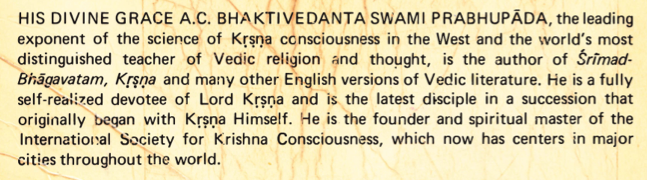
Here Prabhupada is described as “the great exponent”. Contrast this to the original Bhagavad-gita where it is said that Prabhupada is “the leading exponent of Krishna consciousness”. That he is “the world most distinguished teacher of Vedic religion and thought,…”, and that he is a “self-realized devotee of Krishna”.

It’s hard to fathom why the BBT International and their Danish editors are covering up the greatness of both the Bhagavad-gita and Prabhupada. An explanation is needed!

In previous post we have described how the cover art on the new Danish Bhagavad-gita is unauthorized:

https://arsaprayoga.wordpress.com/2013/09/09/cover-up/