King Shifted (Bg. 1.20)

BY: BHAKTA TORBEN

Jun 07, 2015 — DENMARK (SUN) —

Bhagavad-gita As It Is, 1.20:

Screen Shot 2015-06-09 at 12.38.01

Original, authorized 1972 edition: 

“O King, at that time Arjuna, the son of Pāṇḍu, who was seated in his chariot, his flag marked with Hanumān, took up his bow and prepared to shoot his arrows, looking at the sons of Dhṛtarāṣṭra. O King, Arjuna then spoke to Hṛṣīkeśa [Kṛṣṇa] these words:”

Manuscript: 

“Oh the king, at that time Arjuna the son of Pandu who was seated on the chariot with flag marked with Hanuman and while just he was about to throw his arrows taking up the bow, he said unto Lord Krsna as follows after looking on the situated sons of Dhritarastra.”

JAS It Is: 

“At that time Arjuna, the son of Pāṇḍu, seated in the chariot bearing the flag marked with Hanumān, took up his bow and prepared to shoot his arrows. O King, after looking at the sons of Dhṛtarāṣṭra drawn in military array, Arjuna then spoke to Lord Kṛṣṇa these words.”

The words ‘drawn in military array’ are an addition. They are NOT to be found in either the original or the manuscript, nor in the ‘English equivalents’.

The address ‘O King’ starting the verse in both the original and the manuscript is shifted.

The original’s text is perfectly lucid and understandable. No apparent reason to change anything.

Ramesvara Prabhu Speaks About the Paintings in Srila Prabhupada’s Books

Ramesvara Prabhu here speaks about the amazing transcendental pastime of creating the many paintings in Srila Prabhupada’s books – especially the Krishna Book.

He explains how Srila Prabhupada often gave personal instructions to each artist regarding the specific paintings they made.

Unfortunately almost all these transcendental paintings have been removed from Srila Prabhupada’s books and replaced with other paintings that were not made under Srila Prabhupada’s supervision and authorization.

Example of a Bona Fide Change to Srila Prabhupada’s Bhagavad-gita As It Is

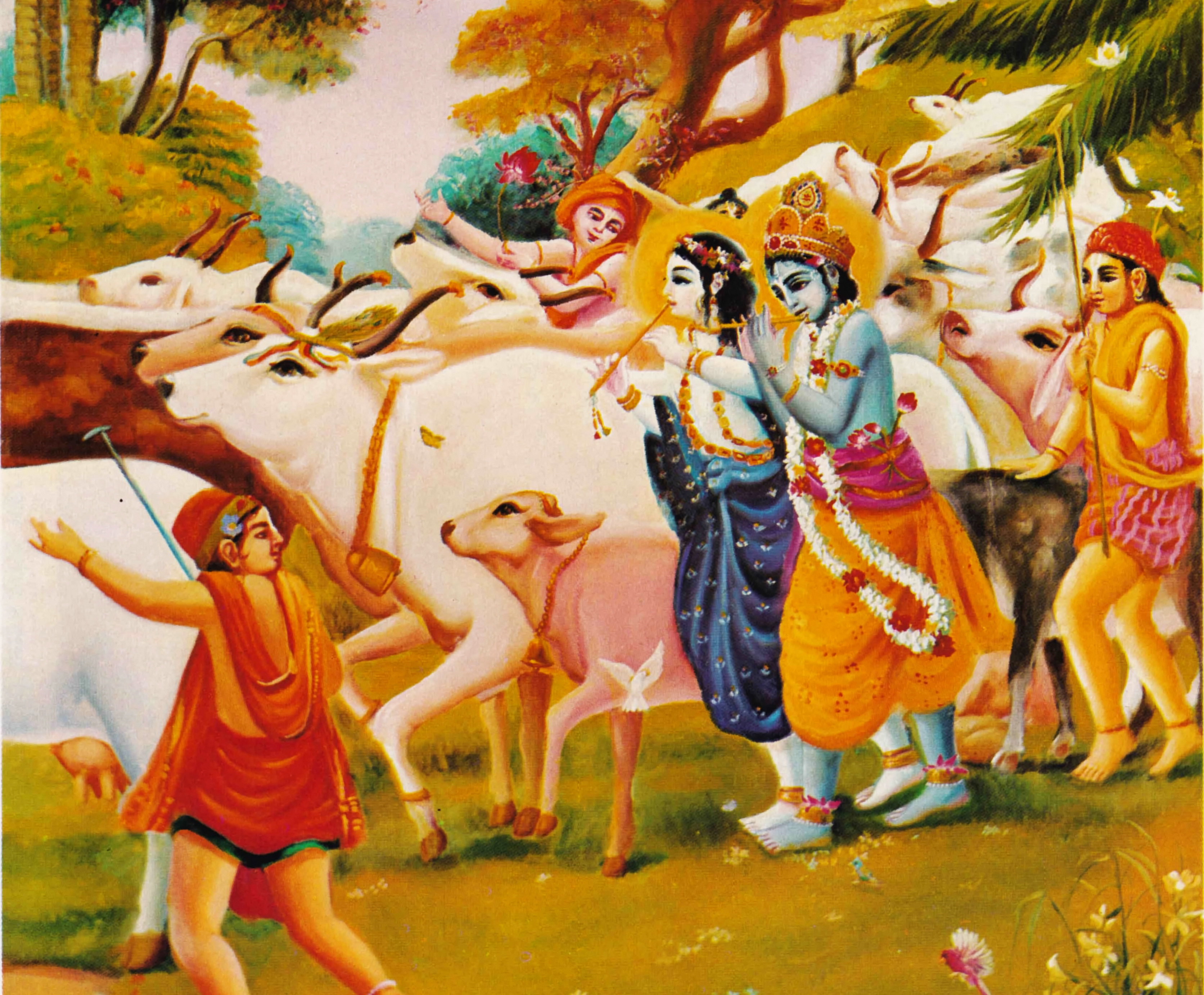
krishna-cows

This is how evidence for bona fide changes looks like:

Room Conversation with the Mayor of Evanston — July 4, 1975, Chicago:

Tamala Krsna: “Farming, cattle raising and business are the qualities…”
Prabhupada: They are not cattle raising, that was…
Tamala Krsna: Cow protection.
Prabhupada: Cow protection. It has to be corrected. It is go-raksya, go. They take it cattle-raising. I think Hayagriva has translated like this.

This change is – contrary to all the post-1977 changes – Prabhupada-approved. It first appeared in a 1976 reprint of the 1968 abridged edition of Bhagavad-gita As It Is.

“Enter Blazing” – Jayadvaita Swami Commits a Grammatical Error (Bg. 11.28)

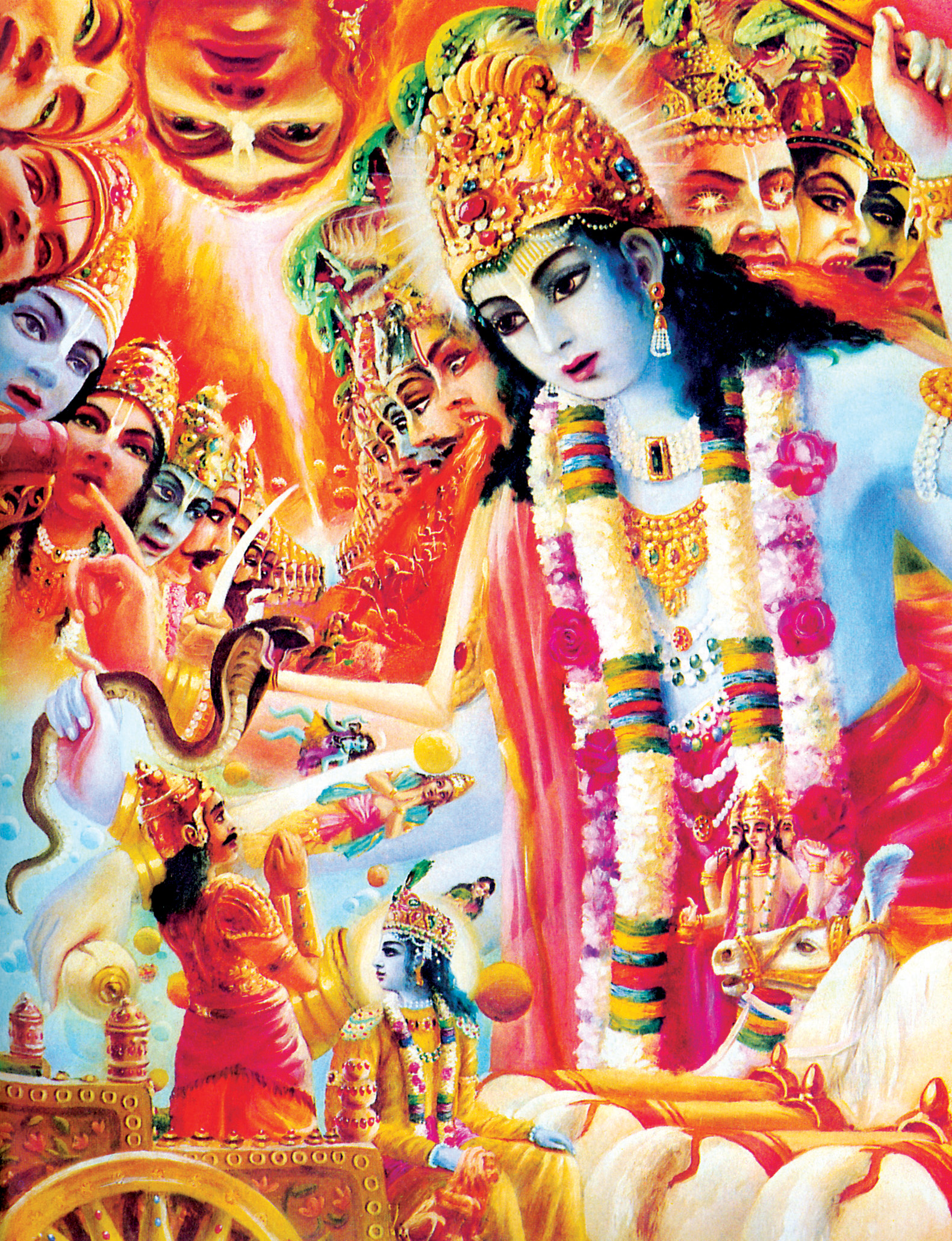
universal-formThe Universal Form

Bhakta Torben Nielsen recently made me aware of this change to Bg. 11.28:

Original and authorized 1972-edition:

“As the rivers flow into the sea, so all these great warriors enter Your blazing mouths and perish.”

BBT International’s edited 1983 edition:

“As the many waves of the rivers flow into the ocean, so do all these great warriors enter blazing into Your mouths.”

So-called original manuscript:

There is no verse for 11.28 as the page is missing. But verse 30 mentions the words “blazing mouths”.

This is a very interesting change, because it is of a grammatical nature:

  • In Srila Prabhupada’s original 1972 edition the adjective “blazing” describes the plural noun “mouths”.
  • In BBT International’s 1983 edition the adjective “blazing” describes the plural noun “warriors”.

So which translation is grammatically correct – Srila Prabhupada’s or Jayadvaita Swami’s?

The context

Here we have the verses from Bg. 11.28-30 (original edition):

“As the rivers flow into the sea, so all these great warriors enter Your blazing mouths and perish.” (Bg. 11.28)

“I see all people rushing with full speed into Your mouths as moths dash into a blazing fire.” (Bg. 11.29)

“O Visnu, I see You devouring all people in Your flaming mouths and covering the universe with Your immeasurable rays. Scorching the worlds, You are manifest.” (Bg. 11.30)

We see that Srila Prabhupada describes the mouths of the universal form as “blazing” (Bg. 11.28) and “flaming” (Bg. 11.30), and compares them to a “blazing fire” (Bg. 11.29). There is no “original manuscript” available for Bg. 11.28-29, but the “original manuscript” for Bg. 11.30 also says “blazing mouths”, as mentioned above.

Screen Shot 2015-03-13 at 11.49.21

Plate 31

The painting above this article is Plate 31 from the Bhagavad-gita As It Is. Just like all other paintings in the book it was approved by Srila Prabhupada. On the painting we clearly see that the warriors are entering into the blazing mouths of The Universal Form – just like we are told that they are in the Bg. 11.28, 1972 edition.

Srila Prabhupada’s desire

Based on the above, there is no doubt at all that Srila Prabhupada wanted to use the adjective “blazing” to describe the mouths of the universal form. He never meant to say that the great warriors were “blazing”.

What does the previous acaryas say about Bg. 11.28? (as translated on bhagavad-gita.org)

Sridhara Swami’s commentary:

“As unlimited currents of water helplessly flow in innumerable rivers and are propelled from multiple channels into the ocean, the mighty warriors of the Kaurava and Pandava armies are seen to be helplessly propelled into the flaming, gnashing mouths of the visvarupa or divine universal form of Lord Krishna.” ()

Kesava Kasmiri’s commentary:

“How helplessly do the mighty warriors of the Kaurava and Pandava armies enter into the flaming mouths of Lord Krishna’s visvarupa or divine universal form? As helplessly as unlimited currents of water from innumerable rivers are propelled into entering the ocean.”

In his translations of Visvanath Cakravarti Thakura and Baladeva Vidyabhusana’s Bhagavad-gita commentaries Bhanu Swami also translates Bg. 11.28 as follows:

“As many swift currents of rivers flow towards the sea, so these heroes of the world enter Your flaming mouths.”

The sanskrit

Gaura Krishna Dasa, a student of sanskrit, sent me the following analysis of the sanskrit grammar:

Regarding the change in the translation of Bhagavad gita 11.28.

The word “abhivijvalanti” is in the 1972 edition taken as what in grammar is called a verbal adjective or a participle. A participle is basically a derivative from a verb but belonging in the group of adjectives. This particular participle is a participle in present tense, active voice for parasmaipada verbs. It is in neuter gender, plural number and in the accusative case which clearly indicates that it relates to “vaktraani” which is also in neuter gender, plural number and accusative case.

Sridhara Swami, Visvanath Cakravati Thakur and Baladeva Vidyabhusana have the same grammatical conclusion of this word as a participle and therefore in relation to “vaktraani” attributively, “blazing mouths”.

The “anti” ending in “abhivijvalanti” could preliminarily appear as a finite verb 3rd person in the plural number and present tense related to “nara-loka-viira” (the kings of human society), but this conclusion is in the least very strange. It would, if accepted, be a distortion of historical facts and it must be concluded faulty because this sentense already has a finite verb namely “visanti” meaning entering. So if we for the sake of example maintain “abhivijvalanti” as a finite verb, as it is done in the 1983 edition it would translate “as the many waves of the rivers flow into the ocean, so all these great warriors enter and blaze your mouth”, since “abhivijvalanti” can also not be taken as an adverb describing “visanti” attributively.

Conclusion:

“abhivijvalanti” must be taken as a participle – as done by the previous acaryas and the original 1972 edition – and not a verb as done in the 1983 edition.

Conclusion

The evidence against Jayadvaita Swami’s change is overwhelming:

1. Srila Prabhupada is very clear in his original Gita and his manuscripts – the mouths are blazing. Not the warriors.

2. Srila Prabhupada follows the previous acaryas who says that the mouths are blazing (flaming, gnashing).

3 The painting depicting this event (Plate 31 in the Bhagavad-gita As It Is) shows that it is the mouths of The Universal Form that are blazing.

4. According to sanskrit grammer it is the “mouths” that are “blazing”. Not the “warriors”.

Even if both translations could be correct (which they cannot), there would still be no justification – based on the above analysis – to change Srila Prabhupada’s translation of the verse.

It would not be possible to do this without overriding his own editorial decisions and thus violating the arsa-prayoga principle.

Please see additional evidence here.

Performer Edit (Bg. 14.19)

BY: BHAKTA TORBEN

Apr 02, 2015 — DENMARK (SUN) —

Bhagavad-gita As It Is, 14.19:

Original, authorized 1972 edition:

“When you see that there is nothing beyond these modes of nature in all activities and that the Supreme Lord is transcendental to all these modes, then you can know My spiritual nature.”

Manuscript:

“When you see that there is nothing beyond these modes of Nature in all activities — and that the Supreme Lord is transcendental to this, then you can know My spiritual Nature.”

Screen Shot 2015-04-03 at 14.58.14

Jas It Is:

“When one properly sees that in all activities no other performer is at work than these modes of nature and he knows the Supreme Lord, who is transcendental to all these modes, he attains My spiritual nature.”

The Original and the manuscript agrees TO THE LETTER. Both the manuscript and the original says `You can know My spiritual nature´, whereas `Jas It Is´ says `he attains to My spiritual nature. The word-for-word says, ‘vetti’- know.

The phrase, ‘no other performer‘ is not found in the original or the manuscript.

NOT CLOSER TO SRILA PRABHUPADA (BG 8.18: MERGED?)

Screen Shot 2015-02-07 at 16.47.24

MERGED?

BY: BHAKTA TORBEN

Feb 03, 2015 — DENMARK (SUN) —

Bhagavad-gita As It Is, 8.18

Authorized Original 1972: 

“When Brahma’s day is manifest, this multitude of living entities comes into being, and at the arrival of Brahma’s night they are all annihilated.”

Science of Self-realization, page 225: 

“When Brahma’s day is manifest, this multitude of living entities comes into being, and at the arrival of Brahma’s night they are all annihilated.”

JAS It Is: 

“At the beginning of Brahmā’s day, all living entities become manifest from the unmanifest state, and thereafter, when the night falls, they are merged into the unmanifest again.”

Manuscript: 

“On the manifest of the Brahma´s day, all living entities, they come into being and when there is arrival of night of Brahma everything becomes annihilated.”

Srila Prabhupada preached heavily against the mayavada concept of ‘merging’. For SURE he did not use the ‘merge’ word in this verse.

A few points from Arsa-Prayoga:

1. Science of Self-Realization was published after the departure of Srila Prabhupada. But it was made on his order. Bhagavad-gita 8.18 was, however, published in Beyond Birth and Death (published while Srila Prabhupada was here) and a Back to Godhead magazine from 1974.

2. Actually Srila Prabhupada used the word “merge” in his original and authorized Gita (like in 2.54). So the most important point here is that Jayadvaita Swami has added words (like merged, manifest, unmanifest, state, falls etc.) to Bg. 8.18 which Srila Prabhupada did not intend to be in Bg. 8.18. Jayadvaita Swami is therefore not telling the truth when he claims he has made the Gita “more faithful to Srila Prabhupada” or “closer to Prabhupada”.

Jayadvaita Swami has made a new translation of the Gita and published it in Srila Prabhupada’a name.

Srila Prabhupada preached heavily against the mayavada concept of `merging´. For SURE he did not use the `merge´ word in this verse.

Rebuttal of Hridayananda Dasa Goswami’s Claims on the Book Changes

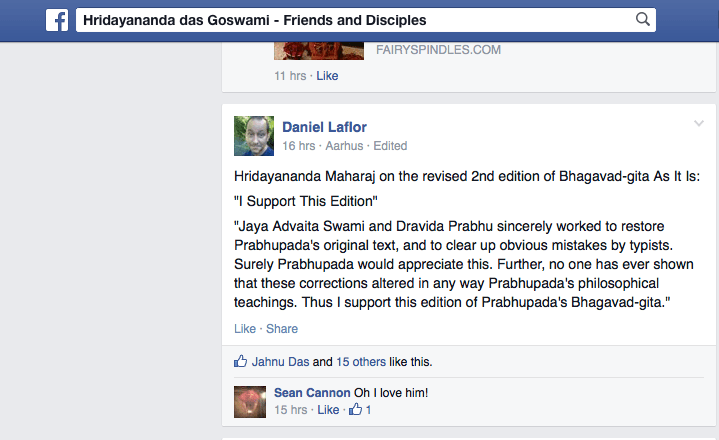
Danesh Dasa posted the following on the facebook group “Hridayananda Das Goswami – Friends and Disciples”:

“Hridayananda Maharaj on the revised 2nd edition of Bhagavad-gita As It Is:

“I Support This Edition”

“Jaya Advaita Swami and Dravida Prabhu sincerely worked to restore Prabhupada’s original text, and to clear up obvious mistakes by typists. Surely Prabhupada would appreciate this. Further, no one has ever shown that these corrections altered in any way Prabhupada’s philosophical teachings. Thus I support this edition of Prabhupada’s Bhagavad-gita.””

Here is a screenshot: Screen Shot 2014-12-11 at 10.55.31
Let us take a look at each of Maharaja’s statements:

Hridayananda Dasa Goswami:

“Jaya Advaita Swami and Dravida Prabhu sincerely worked…”

Hridayananda Dasa Goswami here commits the fallacy of “begging the question” and the fallacy of “Ipse dixit / bare assertion fallacy”:

“Begging the question means “assuming the conclusion (of an argument)”, a type of circular reasoning. This is an informal fallacy where the conclusion that one is attempting to prove is included in the initial premises of an argument, often in an indirect way that conceals this fact.” (Source: http://en.wikipedia.org/wiki/Begging_the_question)

Jayadvaita Swami and Dravida Prabhu did their job sincerely only if they pleased Srila Prabhupada, and we are disagreeing about precisely that. Therefore Maharaja is “begging the question”.

Hridayananda Dasa Goswami needs to give some evidence in support for his claim. But instead of giving evidence he just states it, and this is the fallacy of “Ipse dixit / bare assertion fallacy”:

“Ipse dixit, Latin for “He, himself, said it,” is a term used to identify and describe a sort of arbitrary dogmatic statement which the speaker expects the listener to accept as valid.” (Source: http://en.wikipedia.org/wiki/Ipse_dixit)

Hridayananda Dasa Goswami:

“…to restore Prabhupada’s original text, and to clear up obvious mistakes by typists.”

Here Hridayananda Dasa Goswami commits the fallacy of “selective evidence / fallacy of incomplete evidence”:

“Cherry picking, suppressing evidence, or the fallacy of incomplete evidence is the act of pointing to individual cases or data that seem to confirm a particular position, while ignoring a significant portion of related cases or data that may contradict that position.” (Source: http://en.wikipedia.org/wiki/Cherry_picking_(fallacy))

It is correct that Jayadvaita Swami and BBTI in some cases have changed the books back to what Srila Prabhupada said in the so-called original manuscripts. But is this really a good idea? Normally your drafts end up in your trash bin. If someone took your drafts out of your trash bin and changed your essay back to what you wrote in your drafts without consulting you first, I think you would feel insulted. Here is an article that deals with this unusual idea of changing a text back to its draft:

https://arsaprayoga.com/2013/10/15/jayadvaita-undoes-prabhupadas-work-on-gita-manuscript/

What Hridayananda Dasa Goswami fails to communicate (and possibly comprehend) is the sad fact that in many cases Jayadvaita Swami and BBTI have brought Srila Prabhupada’s books further away from the so-called original texts. They have deleted Srila Prabhupada’s own chosen words and sentences and added their own. They even changed hundreds (if not thousands) of his personally typewritten sanskrit translations. And in most cases there was no reason to do it at all – other than the whimsical preferences of the editors. I have documented many instances of this sort of editing in my e-book “No Reply from BBTI” and on my website www.arsaprayoga.com (see links below).

Hridayananda Dasa Goswami:

“Surely Prabhupada would appreciate this.”

Here Hridayananda Dasa Goswami again commits the fallacy “Ipse dixit / bare assertion fallacy”.

Hridayananda Dasa Goswami:

“Further, no one has ever shown that these corrections altered in any way Prabhupada’s philosophical teachings.”

Since Hridayananda Dasa Goswami presents no evidence to back up his claim, he again commits the fallacy of “Ipse dixit / bare assertion fallacy”.

He claims that no one has been able to demonstrate that Jayadvaita Swami and BBTI have made changes to the philosophy. But by publishing the 1983 edition of the Gita it was openly declared that it is perfectly okay to violate the principle of arsa-prayoga. This is a serious philosophical deviation, and this offensive mentality is now woven into each and every page of Srila Prabhupada’s books, and everyone who reads them will be contaminated by this mentality.

Besides this, now there might only be very few philosophical mistakes made by Jayadvaita Swami and BBTI, but what about the future? If the door is not closed forever, then the changing business might go on forever, since one change justifies the next. Srila Prabhupada was afraid of this (see the famous “Rascal Editors” conversation).

We also know that Jayadvaita Swami has made his own mistakes. One example of this is his changing “Visnu Form” into the “Visnu platform” (Bg. 2.61). This seems to be a change that takes the Gita in the mayavada direction. And here is a link to an article that demonstrates how Jayadvaita Swami has changed a sentence in the Gita so it gets the opposite meaning of what Srila Prabhupada originally said:

Small Word, Big Difference (Bg. 12.2 p.)

Do we want more of these kinds of changes?

Another significant point in this regard is that Hridayananda Dasa Goswami presents an hidden premise, namely that:

All changes that are not of a philosophical nature are okay.

This hidden premise can be disproved by quoting Jayadvaita Swami and the BBTI:

“As you know, and as we kept in mind while doing the work, Srila Prabhupada staunchly opposed needless changes.” (Jayadvaita Swami, Letter to Amogha Lila, 1986)

Now, as we see Srila Prabhupada did not only disapprove of philosophical changes to his books. He also disapproved of “needless changes”. Therefore, if we can find any needless changes in the 1983 edition of the Gita, we know that Jayadvaita Swami and the BBTI have displeased Srila Prabhupada. My contention is that Jayadvaita Swami and the BBTI have made many needless changes (thousands). I have presented some of them in my e-book “No Reply from BBTI”:

https://arsaprayoga.com/2014/05/08/e-book-no-reply-from-bbti/

This e-book shows how the attempted justifications used by the BBTI fails. BBTI usually argue that:

  • We are changing Srila Prabhupada’s books back to what he actually said in his original manuscript.
  • We are making the books “Closer to Prabhupada”.
  • We are only correcting grammar, commas, capitalization etc.
  • We are only correcting the mistakes of previous editors.
  • No unnecessary changes have been made.

But the articles in the e-book documents that the BBT International have needlessly:

  • Deleted many of Srila Prabhupada’s own chosen words and sentences (even those also found in his ”original manuscript”).
  • Added their own words and sentences (which means these words and sentences are also not to be found in the ”original manuscript”).
  • Changed Srila Prabhupada’s own personally typewritten sanskrit translations.
  • Made needless change of syntax (sentence structure).

Hridayananda Dasa Goswami:

“Thus I support this edition of Prabhupada’s Bhagavad-gita.”

If Hridayananda Dasa Goswami had studied this issue carefully he would not support the 1983 edition of the Bhagavad-gita.

Some might argue that Hridayananda Dasa Goswami’s statement is not supposed to be a thorough defense of his views. That is perfectly fine – as long as we recognize that his above statement is completely useless in any kind of debate on the topic.

The interesting question is:

Will Hridayananda Dasa Goswami ever post a thorough defense of his view on this controversial topic? Or does he expect his disciples and well-wishers to blindly accept his statements without any supporting evidence?

We are many who would love to see how he will attempt to justify the editing of Jayadvaita Swami and the BBTI.

Your servant, Ajit Krishna Dasa

Jayadvaita Swami – the Nitpicker

By Robert Jasmin Rintoull

nitpick

“As you know, and as we kept in mind while doing the work, Srila Prabhupada staunchly opposed needless changes.” (Jayadvaita Swami, Letter to Amogha Lila, 1986)

Speaking of needless changes to Prabhupada’s Gita, I found the silliest change of all in chapter 4 vs 22

1972 Gita reads:

“He who is satisfied with gain which comes of its own accord, who is free from duality and does not envy, who is steady BOTH IN success and failure, is never entangled, although performing actions.” (Bg. 4.22, 1972 edition)

Sounds ok doesn’t it?

JAS had ONE small alteration in his 1983 version:

“He who is satisfied with gain which comes of its own accord, who is free from duality and does not envy, who is steady IN BOTH success and failure, is never entangled, although performing actions.” (Bg. 4.22, 1983 edition)

He decided that “IN BOTH” sounded more grammatically or aestethically correct than “BOTH IN”. This is what we would call a nitpicking, pedantic editor!

“As nitpicking inherently requires fastidious, meticulous attention to detail, the term has become appropriated to describe the practice of meticulously searching for minor, even trivial errors in detail (often referred to as “nits” as well), and then criticising them (see hypercriticism).” (http://en.wikipedia.org/wiki/Nitpicking)

But not only that, by this change Jayadvaita Swami changed Srila Prabhupada’s words and brought the Gita further away from Srila Prabhupada. Here is the “original manuscript”:

Screen Shot 2014-11-11 at 09.20.21(Click to enlarge)

Don’t change from this to that. That is your American disease. This is very serious that you always want to change everything. (Srila Prabhupada, Letter to Bhakta dasa, Nov 24, 1974)

Hare Krishna.

Jayadvaita Swami makes a “mad” change!

By Ajit Krishna Dasa

Original and authorized 1972 Bhagavad-gita As It Is, Text 13.1-2 purport:

“Sometimes we understand that I am happy, I am mad, I am a woman, I am a dog, I am a cat: these are the knowers.”

BBT International’s unauthorized 1983 Bhagavad-gita As It Is, Text 13.1-2 purport:

“Sometimes we think, “I am happy,” “I am a man,” “I am a woman,” “I am a dog,” “I am a cat.” These are the bodily designations of the knower.”

Prabhupada’s “original manuscript”:

original-manuscript

The changes are:

1) “we understand” to “we think”

2) “I am mad” to “I am a man”

3) “these are the knowers” to “These are the bodily designations of the knower.”

What we see is that the original editor is true to the “original manuscript” whereas Jayadvaita Swami is not. Here we want to focus solely on the change from “I am mad” to “I am a man”.

Why has Jayadvaita Swami made this change? He gives the following attempted justification on the BBT International’s website:

Screen Shot 2014-09-26 at 06.17.54

This is not a rational justification, but only an unsubstantiated claim that the words in the original Gita are “straight-out nonsense”, “not sacred” and “not the words of Srila Prabhupada”.

Here is our challenge to Jayadvaita Swami.

First of all it is clear that the words from the 1972 edition are not nonsense. “I am happy” and “I am mad” are both states of mind that humans can identify with. Nothing wrong with that. But Jayadvaita Swami speculates that the previous transcribers must have heard wrong, and that “mad” really must have been “a man” instead. I guess his reason is that “a man” fits with “a woman”. “I am a man, I am a woman” then becomes opposites. Just like “cat” and “dog” can be taken as opposites.

But if Jayadvaita Swami was attentive while reading Srila Prabhupada’s books he would have known that Prabhupada often uses “happy” and “mad” as opposites. Even Krishna presents these two states of mind as opposites:

“The mode of goodness conditions one to happiness, passion conditions him to the fruits of action, and ignorance to madness.” (Bg. 14.9)

The mode of goodness and the mode of ignorance have opposite qualities. Krishna here mentions “happiness” and “madness” respectively.

Prabhupada also uses “happy” and “mad” as opposites in other places. Here are a few examples:

Just like a man — ordinarily we perceive — a gentleman, after working very hard, if he gets some bank balance and nice house, nice wife, and some children, he thinks, “I am very happy.” This is also maya. He thinks, “But I am happy.” What kind of maya? Pramattah tesam nidhanam pasyann api na pasyati. He is in maya, mad, illusion, pramatta. (Srimad-Bhagavatam 3.26.22, Bombay, December 31, 1974)

Don’t be very much happy when you are in happy condition of life; neither you become mad in miserable condition of life. (Srimad-Bhagavatam 3.26.47, Bombay, January 22, 1975)

You must have perfect knowledge. Then you’ll be happy. Then you’ll be peace. And if you are misguided, bewildered, mad, then how you can be happy? (Rotary Club Lecture, Ahmedabad, December 5, 1972)

So these are all mad condition. So when he turns to God… Service he must give. Nobody can say, “I’m not serving anybody.” That is not possible. You must be serving somebody. Just like you are serving government, he is serving some office, because service is our nature. So we are not happy because the service is misplaced. (Room Conversation and Interview with Ian Polsen — July 31, 1972, London)

Prabhupada: Even the father, mother is not crying. The mother’s baby dies. She cries, she becomes mad. But when the child gives up that childhood body, accept another body, she’s happy because she knows: “My son is there. (Room Conversation with Anna Conan Doyle, daughter-in-law of famous author, Sir Arthur Conan Doyle, August 10, 1973, Paris)

Pradyumna: It’s Canto Five, Chapter Five, verse number seven. “Even though one may be very learned and wise, he is mad if he does not understand that the endeavor for sense gratification is a useless waste of time. Being forgetful of his own interest, he tries to be happy in the material world, centering his interests around his home, which is based on sexual intercourse and which brings him all kinds of material miseries. In this way one is no better than a foolish animal.” (Room Conversation, February 16, 1977, Mayapur)

Because the mad son is loitering in the street without any information of the father, to bring him back before the father. That is the best. He will be happy. (Room Conversation, March 26, 1977, Bombay)

We are just like a criminal who has dirty things within his heart. He thinks, “If I get such-and-such thing, I’ll be happy.” And at the risk of his life he commits a crime. A burglar, a thief, knows that if he is captured by the police he’ll be punished, but still he goes and steals. Why? Nunam pramattah: he has become mad after sense gratification. (BTG, 1983, The Self And Its Bodies)

CONCLUSION

There is ample evidence to support the claim that the purport of the original Gita has things right. And we see how the original editor is true to Prabhupada’s “original manuscript”. Jayadvaita Swami is changing something that is absolutely perfectly correct from the point of view of grammar, spelling, composition, logic, etc., and at the same time exactly follows the ‘original manuscript’, to something else dreamt up in his mind from his imagination and speculation only. In other words, Jayadvaita Swami here shows no concern for the so-called ‘original manuscript’ and certainly no concern for Srila Prabhupada’s original and authorized 1972 Complete Edition of Bhagavad-gita As It Is.

This is not how an editor is supposed to work. To do what Jayadvaita Swami is doing here is totally unauthorized and completely destroys the authority of Prabhupada’s books.

Not “Closer to Prabhupada” (Bg. 18.2)

Jayadvaita Swami and BBTI’s claim to fame:

Screen Shot 2014-09-04 at 21.27.05

Let us (again) take a look at this claim.

Bhagavad-gita As It Is Text 18.2:

Original and authorized 1972 edition of Bhagavad-gita As It Is: 

“The Supreme Lord said, To give up the results of all activities is called renunciation [tyaga] by the wise. And that state is called the renounced order of life [sannyäsa] by great learned men.”

BBTI’s unauthorized 1983 edition of Bhagavad-gita As It Is:

“The Supreme Personality of Godhead said: The giving up of activities that are based on material desire is what great learned men call the renounced order of life [sannyasa]. And giving up the results of all activities is what the wise call renunciation [tyaga].”

“Original Manuscript”:

Screen Shot 2014-08-30 at 14.23.28 

This is NOT an example of Jayadvaita Swami bringing us “Closer to Prabhupada!” On the contrary, he has (again) taken the Bhagavad-gita As It Is further away from Srila Prabhupada. In other words, we are not reading Srila Prabhupada. We are reading what the hidden co-author, Jayadvaita Swami, wrote.

Their claim to fame is a falsehood.