Desire for Needless Change Fulfilled (Bg, Introduction)

vancha-kalpa

Bhagavad-gita As It Is, Introduction:

Original, authorized 1972 edition: 

vāñchā-kalpatarubhyaś ca kṛpā-sindhubhya eva ca
patitānāṁ pāvanebhyo vaiṣṇavebhyo namo namaḥ

“I offer my respectful obeisances unto all the Vaiṣṇava devotees of the Lord who can fulfill the desires of everyone, just like desire trees, and who are full of compassion for the fallen souls.”

JAS It Is:

vāñchā-kalpa-tarubhyaś ca
kṛpā-sindhubhya eva ca
patitānāṁ pāvanebhyo
vaiṣṇavebhyo namo namaḥ

“I offer my respectful obeisances unto all the Vaiṣṇava devotees of the Lord. They can fulfill the desires of everyone, just like desire trees, and they are full of compassion for the fallen souls.”

Jayadvaita Swami, Letter to Amogha Lila, 1986:

“Srila Prabhupada staunchly opposed needless changes.”

One Example Out of Many Disproves Editor’s  Own Words (Bg. 13.25)

Bg. 13-25

BY: BHAKTA TORBEN

Jun 21, 2015 — DENMARK (SUN) — 

Bhagavad-gita As It Is, 13.25:

Original, authorized 1972 edition: 

That Supersoul is perceived by some through meditation, by some through the cultivation of knowledge, and by others through working without fruitive desire.”

Manuscript: 

That Supersoul is perceived by some through meditation, and by some through the cultivation of knowledge, and by others through working without fruitive desire.”

JAS It Is: 

Some perceive the Supersoul within themselves through meditation, others through the cultivation of knowledge, and still others through working without fruitive desires.”

The original 1972 standard and the so-called manuscript are completely identical. And well articulated. Still the ‘JAS It Is’ model chooses a different phrasing.

As seen many times before.

Here are some important words from the principal editor to Srila Prabhupada’ s books after His Divine Grace’ s departure. On the policy of editing:

“‘Arsa-Prayoga’ is a very important principle. The editor should never have the mentality that he is better than the author, that he has something more to contribute than the author does, that the author really doesn’t know what he is doing, but he knows what he is doing. That’ s offensive and that ruins everything. It is an offense to the acarya. The idea however that this sort of sanctity that the authors’ s has, or that the words of the author has, have, somehow extends to the mistakes of the editors is weird. It is an offense to correct the mistakes of previous editors! Are they acaryas? Are they paramahamsas? Are they infallible? They are wonderful devotees, they did wonderful service, but they made mistakes. Understandable.”

We advise the reader to ponder the gap between theoretical intent and actual action. This example is by far not an isolated case.

Uneven Edit (Bg. 2.48)

bg-2-48

BY: BHAKTA TORBEN

Jun 17, 2015 — DENMARK (SUN) —  Bhagavad-gita As It Is, 2.48:

Original, authorized 1972 edition: 

“Be steadfast in yoga, O Arjuna. Perform your duty and abandon all attachment to success or failure. Such evenness of mind is called yoga.”

Manuscript: 

“Do your prescribed duty in an equipoised condition. To do such duty without being attached to success or failure, and to remain in an equiposed condition is called Yoga.”

Read Aloud to Srila Prabhupada by Tamala Krishna in London, 1968: 

“Be steadfast in your duty, O Arjuna, and abandon all attachment to success or failure. Such evenness of mind is called yoga [Bg. 2.48].”

And immediately after Tamal Krishna’s reading of the verse Srila Prabhupada says:

“This is the explanation of yoga, evenness of mind. Yoga-samatvam ucyate. If you work for Krsna, then there is no cause of lamentation or jubilation. Jubilation is there because you are working for Krsna, but there is no cause of lamentation. Yoga-sthah kuru karmani, yogah karmasu kausalam. That is the secret of activities, how you can very diligently work at the same time you are not entangled with the actions. That is the secret. Go on.”

The word-for-word reads ‘samatvam – evenness of mind‘ (Original), but the heavily edited ‘JAS It Is’ version says in the word-for-word ‘samatvam – equanimity’.

‘JAS It Is’:

“Perform your duty equipoised, O Arjuna, abandoning all attachment to success or failure. Such equanimity is called yoga.”

Once again we observe an absolutely unnecessary change. This verse in the original 1972 edition is perfect.

There are more irregularities. Check it out.

Failed De-Sexing Edit Attempt (Bg. 2.23 and 2.24)

BY: BHAKTA TORBEN

May 14, 2015 — DENMARK (SUN) —

Bhagavad-gita As It Is, 2.23:

Screen Shot 2015-06-11 at 13.38.38

Original, authorized 1972 edition: 

“The soul can never be cut into pieces by any weapon, nor can he be burned by fire, nor moistened by water, nor withered by the wind.”

Manuscript: 

“The soul can never be cut into peices by any kind of weapon, neither can he be burnt by fire, nor can He be moistened by water, nor can he be dried up by the wind.”

JAS It Is: 

“The soul can never be cut to pieces by any weapon, nor burned by fire, nor moistened by water, nor withered by the wind.”

Although both the manuscript and the original says he about the soul, the JAS It is-version has, for unknown reasons, dropped the pronoun.

Paradoxically, however, ‘Jas It Is’ version in the ensuing verse, 2.24, does NOT drop the pronoun ‘he‘ for the soul:

Bhagavad-gita As It Is 2.24:

Original, authorized 1972 edition: 

“This individual soul is unbreakable and insoluble, and can be neither burned nor dried. He is everlasting, all-pervading, unchangeable, immovable and eternally the same.”

Manuscript: 

“This individual soul is unbreakable, cannot be burnt, insoluble, nondriable, everlasting, present everywhere, unchangeable, immovable and eternally the same.”

JAS It Is. 2.24:

“This individual soul is unbreakable and insoluble, and can be neither burned nor dried. He is everlasting, present everywhere, unchangeable, immovable and eternally the same.”

So the ‘JAS It Is’ edit-strategy seems to be pretty fickle. “Should we, or shouldn’t we?”

Anyway, why not just stick to the original? It is pretty clear.

In London, 1973, BOTH of the original’s verses were read aloud to Srila Prabhupada.

Superfluous and Awkward (Bg. 3.26)

BY: BHAKTA TORBEN

May 18, 2015 — DENMARK (SUN) —

Bhagavad-gita As It Is, 3.26:

Screen Shot 2015-06-10 at 12.21.52

Original, authorized 1972 edition: 

“Let not the wise disrupt the minds of the ignorant who are attached to fruitive action. They should not be encouraged to refrain from work, but to engage in work in the spirit of devotion.”

Manuscript: 

“Those who are after the fruitive results of prescribed duties may not be induced to stop work, disrupt his intelligence. Rather they should be engaged in all sorts of activities, for gradual development of Krsna consciousness.”

JAS It Is:

“So as not to disrupt the minds of ignorant men attached to the fruitive results of prescribed duties, a learned person should not induce them to stop work. Rather, by working in the spirit of devotion, he should engage them in all sorts of activities [for the gradual development of Krishna consciousness].”

The original is fine and lucid.

The ‘Jas It Is’ edition is a threefold mix of the original and the manuscript plus added stuff, i.e., the words ‘So as not to’ and ‘a learned person’ .

The bracketed sentence in the end ‘for the gradual development of Krishna consciousness’ is a pleonasm to the sentence ‘working in the spirit of devotion’, therefore superfluous and the end-result is awkward.

There is more, check it out.

King Shifted (Bg. 1.20)

BY: BHAKTA TORBEN

Jun 07, 2015 — DENMARK (SUN) —

Bhagavad-gita As It Is, 1.20:

Screen Shot 2015-06-09 at 12.38.01

Original, authorized 1972 edition: 

“O King, at that time Arjuna, the son of Pāṇḍu, who was seated in his chariot, his flag marked with Hanumān, took up his bow and prepared to shoot his arrows, looking at the sons of Dhṛtarāṣṭra. O King, Arjuna then spoke to Hṛṣīkeśa [Kṛṣṇa] these words:”

Manuscript: 

“Oh the king, at that time Arjuna the son of Pandu who was seated on the chariot with flag marked with Hanuman and while just he was about to throw his arrows taking up the bow, he said unto Lord Krsna as follows after looking on the situated sons of Dhritarastra.”

JAS It Is: 

“At that time Arjuna, the son of Pāṇḍu, seated in the chariot bearing the flag marked with Hanumān, took up his bow and prepared to shoot his arrows. O King, after looking at the sons of Dhṛtarāṣṭra drawn in military array, Arjuna then spoke to Lord Kṛṣṇa these words.”

The words ‘drawn in military array’ are an addition. They are NOT to be found in either the original or the manuscript, nor in the ‘English equivalents’.

The address ‘O King’ starting the verse in both the original and the manuscript is shifted.

The original’s text is perfectly lucid and understandable. No apparent reason to change anything.

Ramesvara Prabhu Speaks About the Paintings in Srila Prabhupada’s Books

Ramesvara Prabhu here speaks about the amazing transcendental pastime of creating the many paintings in Srila Prabhupada’s books – especially the Krishna Book.

He explains how Srila Prabhupada often gave personal instructions to each artist regarding the specific paintings they made.

Unfortunately almost all these transcendental paintings have been removed from Srila Prabhupada’s books and replaced with other paintings that were not made under Srila Prabhupada’s supervision and authorization.

Example of a Bona Fide Change to Srila Prabhupada’s Bhagavad-gita As It Is

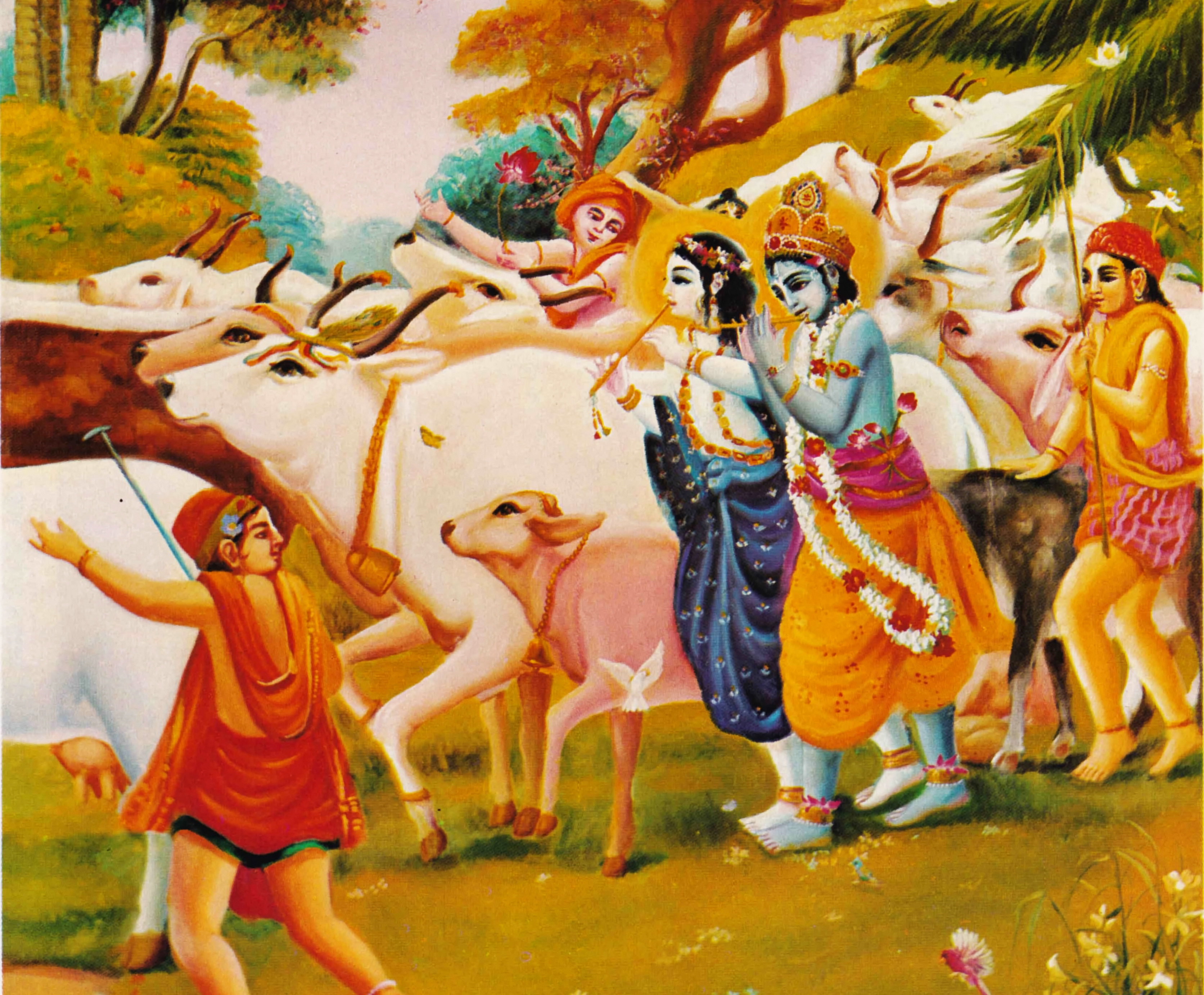
krishna-cows

This is how evidence for bona fide changes looks like:

Room Conversation with the Mayor of Evanston — July 4, 1975, Chicago:

Tamala Krsna: “Farming, cattle raising and business are the qualities…”
Prabhupada: They are not cattle raising, that was…
Tamala Krsna: Cow protection.
Prabhupada: Cow protection. It has to be corrected. It is go-raksya, go. They take it cattle-raising. I think Hayagriva has translated like this.

This change is – contrary to all the post-1977 changes – Prabhupada-approved. It first appeared in a 1976 reprint of the 1968 abridged edition of Bhagavad-gita As It Is.

“Enter Blazing” – Jayadvaita Swami Commits a Grammatical Error (Bg. 11.28)

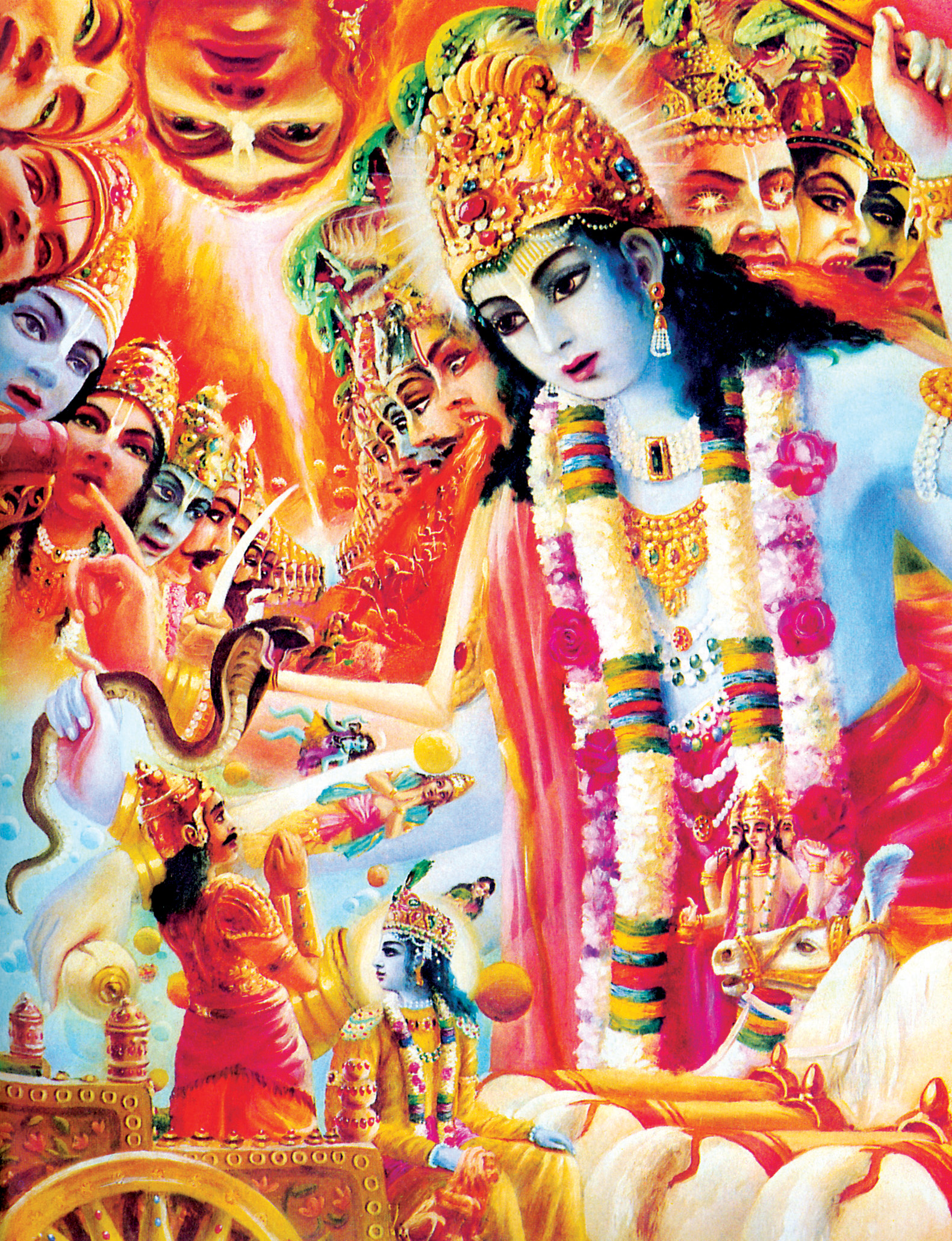
universal-formThe Universal Form

Bhakta Torben Nielsen recently made me aware of this change to Bg. 11.28:

Original and authorized 1972-edition:

“As the rivers flow into the sea, so all these great warriors enter Your blazing mouths and perish.”

BBT International’s edited 1983 edition:

“As the many waves of the rivers flow into the ocean, so do all these great warriors enter blazing into Your mouths.”

So-called original manuscript:

There is no verse for 11.28 as the page is missing. But verse 30 mentions the words “blazing mouths”.

This is a very interesting change, because it is of a grammatical nature:

  • In Srila Prabhupada’s original 1972 edition the adjective “blazing” describes the plural noun “mouths”.
  • In BBT International’s 1983 edition the adjective “blazing” describes the plural noun “warriors”.

So which translation is grammatically correct – Srila Prabhupada’s or Jayadvaita Swami’s?

The context

Here we have the verses from Bg. 11.28-30 (original edition):

“As the rivers flow into the sea, so all these great warriors enter Your blazing mouths and perish.” (Bg. 11.28)

“I see all people rushing with full speed into Your mouths as moths dash into a blazing fire.” (Bg. 11.29)

“O Visnu, I see You devouring all people in Your flaming mouths and covering the universe with Your immeasurable rays. Scorching the worlds, You are manifest.” (Bg. 11.30)

We see that Srila Prabhupada describes the mouths of the universal form as “blazing” (Bg. 11.28) and “flaming” (Bg. 11.30), and compares them to a “blazing fire” (Bg. 11.29). There is no “original manuscript” available for Bg. 11.28-29, but the “original manuscript” for Bg. 11.30 also says “blazing mouths”, as mentioned above.

Screen Shot 2015-03-13 at 11.49.21

Plate 31

The painting above this article is Plate 31 from the Bhagavad-gita As It Is. Just like all other paintings in the book it was approved by Srila Prabhupada. On the painting we clearly see that the warriors are entering into the blazing mouths of The Universal Form – just like we are told that they are in the Bg. 11.28, 1972 edition.

Srila Prabhupada’s desire

Based on the above, there is no doubt at all that Srila Prabhupada wanted to use the adjective “blazing” to describe the mouths of the universal form. He never meant to say that the great warriors were “blazing”.

What does the previous acaryas say about Bg. 11.28? (as translated on bhagavad-gita.org)

Sridhara Swami’s commentary:

“As unlimited currents of water helplessly flow in innumerable rivers and are propelled from multiple channels into the ocean, the mighty warriors of the Kaurava and Pandava armies are seen to be helplessly propelled into the flaming, gnashing mouths of the visvarupa or divine universal form of Lord Krishna.” ()

Kesava Kasmiri’s commentary:

“How helplessly do the mighty warriors of the Kaurava and Pandava armies enter into the flaming mouths of Lord Krishna’s visvarupa or divine universal form? As helplessly as unlimited currents of water from innumerable rivers are propelled into entering the ocean.”

In his translations of Visvanath Cakravarti Thakura and Baladeva Vidyabhusana’s Bhagavad-gita commentaries Bhanu Swami also translates Bg. 11.28 as follows:

“As many swift currents of rivers flow towards the sea, so these heroes of the world enter Your flaming mouths.”

The sanskrit

Gaura Krishna Dasa, a student of sanskrit, sent me the following analysis of the sanskrit grammar:

Regarding the change in the translation of Bhagavad gita 11.28.

The word “abhivijvalanti” is in the 1972 edition taken as what in grammar is called a verbal adjective or a participle. A participle is basically a derivative from a verb but belonging in the group of adjectives. This particular participle is a participle in present tense, active voice for parasmaipada verbs. It is in neuter gender, plural number and in the accusative case which clearly indicates that it relates to “vaktraani” which is also in neuter gender, plural number and accusative case.

Sridhara Swami, Visvanath Cakravati Thakur and Baladeva Vidyabhusana have the same grammatical conclusion of this word as a participle and therefore in relation to “vaktraani” attributively, “blazing mouths”.

The “anti” ending in “abhivijvalanti” could preliminarily appear as a finite verb 3rd person in the plural number and present tense related to “nara-loka-viira” (the kings of human society), but this conclusion is in the least very strange. It would, if accepted, be a distortion of historical facts and it must be concluded faulty because this sentense already has a finite verb namely “visanti” meaning entering. So if we for the sake of example maintain “abhivijvalanti” as a finite verb, as it is done in the 1983 edition it would translate “as the many waves of the rivers flow into the ocean, so all these great warriors enter and blaze your mouth”, since “abhivijvalanti” can also not be taken as an adverb describing “visanti” attributively.

Conclusion:

“abhivijvalanti” must be taken as a participle – as done by the previous acaryas and the original 1972 edition – and not a verb as done in the 1983 edition.

Conclusion

The evidence against Jayadvaita Swami’s change is overwhelming:

1. Srila Prabhupada is very clear in his original Gita and his manuscripts – the mouths are blazing. Not the warriors.

2. Srila Prabhupada follows the previous acaryas who says that the mouths are blazing (flaming, gnashing).

3 The painting depicting this event (Plate 31 in the Bhagavad-gita As It Is) shows that it is the mouths of The Universal Form that are blazing.

4. According to sanskrit grammer it is the “mouths” that are “blazing”. Not the “warriors”.

Even if both translations could be correct (which they cannot), there would still be no justification – based on the above analysis – to change Srila Prabhupada’s translation of the verse.

It would not be possible to do this without overriding his own editorial decisions and thus violating the arsa-prayoga principle.

Please see additional evidence here.

Performer Edit (Bg. 14.19)

BY: BHAKTA TORBEN

Apr 02, 2015 — DENMARK (SUN) —

Bhagavad-gita As It Is, 14.19:

Original, authorized 1972 edition:

“When you see that there is nothing beyond these modes of nature in all activities and that the Supreme Lord is transcendental to all these modes, then you can know My spiritual nature.”

Manuscript:

“When you see that there is nothing beyond these modes of Nature in all activities — and that the Supreme Lord is transcendental to this, then you can know My spiritual Nature.”

Screen Shot 2015-04-03 at 14.58.14

Jas It Is:

“When one properly sees that in all activities no other performer is at work than these modes of nature and he knows the Supreme Lord, who is transcendental to all these modes, he attains My spiritual nature.”

The Original and the manuscript agrees TO THE LETTER. Both the manuscript and the original says `You can know My spiritual nature´, whereas `Jas It Is´ says `he attains to My spiritual nature. The word-for-word says, ‘vetti’- know.

The phrase, ‘no other performer‘ is not found in the original or the manuscript.